
Masseter Botox for Jaw Slimming and Bruxism
Reviewed for medical accuracy against our Medical Review Board · Last updated 18 August 2026
Part of Botox by Facial Area
Masseter Botox takes the largest dose used anywhere in facial aesthetics, and it works on a completely different timetable from the rest of your face. Relief from clenching arrives in two to four weeks. Visible jaw slimming takes two to three months, because you are waiting for the muscle to shrink, not just relax.
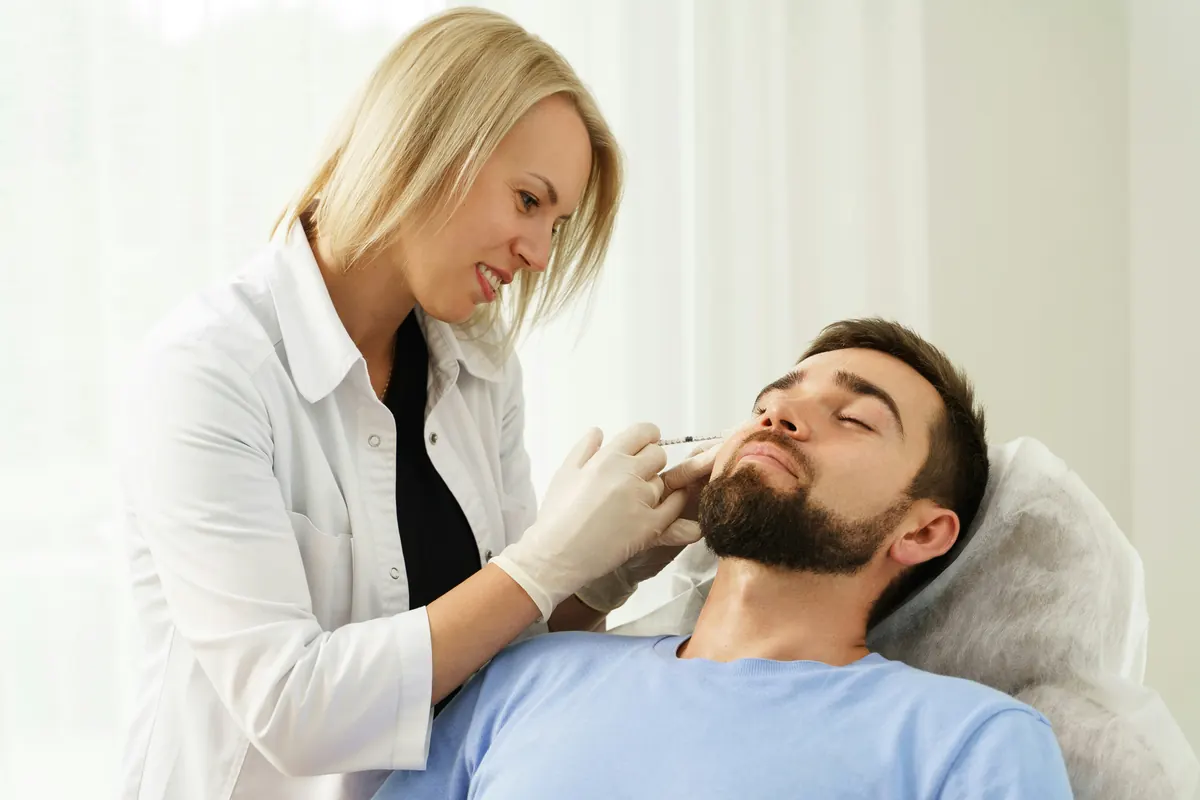
The masseter is the thick muscle at the angle of your jaw that closes your bite. Treating it does two quite different jobs depending on why you are there: it narrows a wide lower face, and it takes the force out of clenching and grinding. Those are not the same treatment, they do not use the same dose, and only one of them has any chance of being covered by insurance.
1. What the masseter is, and what treating it does
Put your fingers on the side of your jaw, just below and forward of your earlobe, and clench. The slab of muscle that bulges under your fingers is the masseter. It is one of the strongest muscles in the body relative to its size, and its job is to close your bite.
Relaxing it with a neurotoxin produces two effects, and it is worth being clear which one you are buying:
- Slimming. A muscle that is used less loses bulk. Over weeks, the masseter shrinks, and the widest part of the lower face narrows. This is a cosmetic outcome and it is why most people book.
- Relief. A muscle that cannot contract at full force stops generating the same pressure, so clenching and grinding do less damage and hurt less. This is the therapeutic outcome, and for a lot of people it is the one that actually changes their life.
Many patients want both. They arrive asking for a slimmer face and leave most grateful that they stopped waking up with a sore jaw.
2. The ten-second test for whether this will work on you
This is the most useful thing on this page, and it is where most of the wasted money in this treatment goes.
Do this now. Look straight into a mirror with your jaw relaxed and note the width of your lower face. Now clench hard. If the widest point bulges outward noticeably when you clench, the width is muscle, and a neurotoxin will narrow it. If the outline barely changes, the width is bone or soft tissue, and no dose of any toxin will alter it.
Three different things make a lower face look wide, and only the first responds to Botox:
- Masseter bulk. Responds well. Common in people who clench, grind, chew a lot of firm food, or have simply always had a strong bite.
- Bone, specifically the angle of the mandible. Does not respond at all. If your jaw is wide at the bone, changing that is surgery, not injections.
- Buccal fat and general facial fullness. Does not respond. Different problem, different treatments.
An injector who examines you clenched and unclenched before quoting is doing the assessment. One who quotes a unit count off a photograph is not. If they tell you a wide bony jaw will slim with Botox, get a second opinion.
3. Off-label twice over, and why that matters
Botox Cosmetic holds FDA approval for exactly four cosmetic areas: frown lines, crow's feet, forehead lines and platysma bands in the neck, the last added in the label revised October 2024. Botox also holds separate medical approvals, including chronic migraine, cervical dystonia and severe underarm sweating.
The masseter appears on neither list. Treating it for jaw slimming is off-label, and treating it for bruxism or TMJ discomfort is also off-label. There is no approved indication for either use in the United States.
That does not make it improper. Off-label prescribing is legal, extremely common, and often the right clinical decision. What it does mean is real and worth understanding:
- Dosing comes from practice and published clinical experience rather than from trials submitted for approval, so your individual injector's judgement carries more weight here than it does for crow's feet or the glabella.
- Insurers use it as grounds to refuse, which is the subject of section 7.
- Your injector should tell you unprompted. Someone who presents masseter Botox as an approved treatment either does not know or is not telling you.
4. The largest dose in facial aesthetics
The masseter takes more units than any other area treated for appearance, because it is simply far more muscle. Doses are quoted per side, since the two sides are frequently not the same size.
Typical practice runs from around 20 to 30 units per side for slimming, and higher for a large or heavily exercised muscle or where the main goal is relieving a powerful clench. That puts a full treatment in the region of 40 to 60 units in total, against 20 for a whole forehead.
Three things drive where you land:
- How big the muscle is, assessed by feel while you clench. This is why the physical exam is not optional.
- Asymmetry. Most people chew preferentially on one side. A good injector doses the sides differently rather than splitting a number in half, and that is a sign of care rather than inconsistency.
- Which outcome you want. Relief from clenching can often be achieved at a lower dose than visible slimming, because you only need to take the peak force off, not shrink the muscle.
Our units guide and calculator covers dosing for every area, and it lists this one as a combined figure rather than per side.
5. The timeline nobody explains properly
If you take one thing from this article, take this. Masseter Botox does not behave like the upper face, and people judge it far too early.
| When | What you should notice |
|---|---|
| Days 3 to 7 | Clenching starts to feel weaker. Some people notice their bite feels less forceful on hard food. |
| Weeks 2 to 4 | Jaw tension, morning soreness and headache from grinding often improve. Appearance largely unchanged. |
| Weeks 6 to 8 | Narrowing begins to be visible, usually to you before anyone else. |
| Weeks 10 to 12 | Close to the full slimming effect. This, not week two, is when to judge the result. |
| Months 4 to 6+ | Effect fades gradually. Often longer-lasting than the upper face, because bulk has to rebuild rather than nerve signalling simply recovering. |
The consequence is practical: do not book this six weeks before a wedding and expect a slimmer face. And do not conclude at your two-week review that it has not worked, which is the single most common mistake. For the upper face, two weeks is the review point. Here it tells you almost nothing about the cosmetic outcome. Compare forehead lines, where two weeks is the full effect.
6. Before and after, and why the photographs are the weakest evidence here
Search for masseter Botox before and after and you get galleries. They are the least reliable thing you can judge this treatment on, and for this area specifically the reason is mechanical rather than cynical.
Apparent jaw width changes with things that have nothing to do with treatment. Whether the jaw is clenched or relaxed moves the outline more than a course of treatment does, because a contracted masseter visibly bulges. Head rotation of a few degrees changes the width of the lower face in frame. Lens focal length changes it again: a short lens close to the face broadens the jaw, a longer lens from further back narrows it. Lighting from above thins the lower face by putting the mandible in shadow. None of that requires anyone to be dishonest, and all of it is present in a typical clinic gallery where the two photographs were taken weeks apart on a phone.
Then there is timing, which the table above already covers and most galleries ignore. Relaxation is a nerve effect and arrives in days. Slimming needs the muscle to lose bulk through reduced use, and that is close to complete somewhere around weeks 10 to 12. A pair of photographs taken two weeks apart cannot show the cosmetic result, because at two weeks the cosmetic result has not happened yet. If a gallery does not say how many weeks separate the two images, it is not evidence of anything.
How to take a pair you can actually use
Photograph yourself, under conditions you control, and you will get something more useful than any gallery:
- Jaw relaxed, teeth apart, lips together. Do it twice, once relaxed and once clenched, and compare like with like. The clenched pair is where the change shows most clearly.
- Same spot, same light, same time of day. A window at a fixed position beats a bathroom mirror.
- Arm's length or further, camera at eye level. Closer than that and the lens is doing the work.
- Front and both three-quarter views. Masseter bulk reads most clearly from three-quarters, not straight on.
- Day 0, week 6, week 12. Week 12 is the honest comparison point. Anything earlier undersells it and anything later starts to catch the fade.
One thing no photograph shows: whether your jaw stopped hurting. If you came to this for clenching or grinding rather than for face shape, the outcome that matters arrives around weeks 2 to 4 and is invisible in every gallery ever published.
7. What it costs at real published rates
Because it takes the most units, this is the most expensive single area on the face. Below is 40 to 60 units against the per-unit prices actually published by clinics in the cities we verify.
| Published rate | Per unit | 40 to 60 units |
|---|---|---|
| Lowest we found | $9 | $360 to $540 |
| Middle of the range | $12 | $480 to $720 |
| Highest we found | $18 | $720 to $1,080 |
These are rates clinics actually publish, read off their own price pages rather than estimated: the floor is $9 a unit in Atlanta, GA and the ceiling $18 in Tampa, FL. Your own city may sit outside that range entirely. We check published pricing city by city, and the locations index lists every city covered so far, with the named clinics and their rates.
A caution specific to this area: many clinics quote the masseter as a flat fee rather than per unit, sometimes described as starting from a figure. That can be better or worse value than per-unit pricing, and it depends entirely on how many units your muscle actually needs, so ask how many units the flat fee covers and what happens if you need more. Our Botox price guide covers the per-unit versus per-area question in general.
Budget for repeat treatment. The slimming reverses if you stop, though many people find they need it less often after two or three rounds.
8. Insurance, honestly
The short version: cosmetic slimming is never covered. Treatment for a documented medical problem sometimes is, and the default answer is still no.
Here is why. Insurers will not pay for appearance, so if the reason on the record is a narrower jaw, that is the end of it. Where there is a genuine medical case, bruxism causing tooth damage or TMJ dysfunction causing pain, coverage becomes possible. But because the use is off-label, insurers have a straightforward ground to decline even a well-documented request, and many do so as a matter of course.
What improves your odds:
- A diagnosis on record from a dentist, oral surgeon or physician, not an aesthetic clinic.
- Documented history: worn or cracked teeth, a night guard that has not solved it, pain, headaches, a record of the problem over time.
- Evidence that cheaper options were tried first. A night guard is the usual prerequisite.
- A provider who will code and document it as a medical treatment and support an appeal. Most med spas neither can nor will.
The route that works far more often than insurance is an HSA or FSA, which will generally cover a medically necessary treatment with the right documentation, without needing the insurer to approve anything. If clenching is your real problem, that is the practical answer, and it is worth asking about before you assume you are paying cash.
One honest note on sequencing: if you want both slimming and relief, get the medical assessment first. It is very hard to build a medical record after you have been treated cosmetically.
9. The risks worth knowing before, not after
- Chewing fatigue. Very common for the first two to four weeks. Steak, crusty bread and chewing gum feel like work. It settles, and it is a sign the treatment is doing what it should.
- Asymmetry. Sides that were already unequal can look more so if dosed as if they were identical, or if you continue favouring one side. Usually correctable at review.
- Paradoxical bulging. Occasionally a part of the muscle that was not treated compensates and pushes outward, most visibly when clenching. It happens when the injection pattern misses part of a large muscle, and it is fixable with a small additional dose in the right place.
- A hollow or gaunt look if too much is taken off, particularly in a slim face with little fat to soften the change. Slimming this area is not always flattering, and a good injector will say so.
- Smile changes if the injection is placed too high or too far forward, where nearby muscles that lift the mouth can be affected.
All of these resolve as the toxin wears off, which here means months rather than weeks. There is no reversal agent, so the argument for starting conservatively is stronger in this area than anywhere else.
10. What repeated treatment does over years
Something to think about, and rarely raised at consultation.
Repeated treatment keeps the muscle smaller. Sustained over years, the volume loss is part of what holds the lower face up, and some people find the change stops being purely flattering as they get older or if they lose weight. The masseter is not just an aesthetic problem to be minimised; it is structural tissue.
This is not an argument against treatment. It is an argument for treating to the appearance you want rather than to the maximum narrowing achievable, for spacing treatments as far apart as the result allows, and for reassessing rather than automatically rebooking. If your injector's plan is the same dose every twelve weeks indefinitely with no review of whether you still need it, ask why.
11. What to ask before you agree
- Will you feel my jaw while I clench before quoting? The answer should be yes, and it should happen.
- Is my width muscle, bone or fat? If they will not distinguish, do not book.
- How many units per side, and are you dosing the two sides differently?
- Am I here for slimming, for clenching relief, or both, and does that change the dose?
- When should I judge the result? A good answer is around ten to twelve weeks, not two.
- Flat fee or per unit, how many units does it cover, and what if I need more?
- If clenching is my problem, can you document it so I can use my HSA or FSA?
And the check that costs nothing: confirm your injector holds a current license. The records are public and free. We list the lookup for every state in how to verify a Botox injector's license.
What an on-label medical claim looks like. Compare this with Botox for severe underarm sweating, which is FDA approved for that exact use at 50 units a side. That approval is why its insurance path is straightforward and this one is not.
The other end of the dose range. This is the largest dose in facial aesthetics. The smallest is the lip flip, at four units, and it wears off in weeks rather than months.
Every area Botox treats, and what each one takes
Botox is not one treatment, it is eight or so, and the dose ranges by a factor of thirty between the smallest and the largest. 4 of these areas are on the FDA label; the rest are off-label, which is legal and common but means the dose comes from clinical practice rather than from a registration trial.
| Area | Typical dose | FDA status |
|---|---|---|
| Frown lines (glabella) | 20 units | FDA approved |
| Forehead lines | 20 units, with the glabella | FDA approved |
| Crow's feet | 24 units | FDA approved |
| Neck and platysmal bands | 26 to 36 units | FDA approved |
| Brow lift | 4 to 12 units | Off-label |
| Lip flip | 2 to 6 units | Off-label |
| Masseter (jaw slimming) (you are here) | 40 to 60 units | Off-label |
| Under the eyes | 1 to 4 units per side | Off-label |
| Bunny lines (nose) | 2 to 5 units per side | Off-label |
| Gummy smile | 2 to 3 units per side | Off-label |
| Marionette lines | 2 to 8 units per side | Off-label |
Units are not comparable between brands, so these are Botox units. Full ranges per area are in the units guide and calculator.
Frequently asked questions
How many units of Botox for masseter jaw slimming?
How long does masseter Botox take to work?
Is masseter Botox FDA approved?
Will masseter Botox slim my face if my jaw is wide?
Is masseter Botox covered by insurance?
How much does masseter Botox cost?
Does masseter Botox last longer than forehead Botox?
What are the side effects of masseter Botox?

Sources
Every figure on this page was read from the documents below rather than from a clinic or a manufacturer's marketing. They open in a new tab so you can check any claim here against its source.
- BOTOX Cosmetic prescribing information, FDA via DailyMed
- BOTOX prescribing information, therapeutic indications, FDA via DailyMed
Keep reading
 Botox Treatment AreasThe Botox Brow Lift
 Botox Treatment AreasBotox for Crow's Feet
 Botox Treatment AreasBotox for Forehead Lines
 Botox Treatment AreasBotox for Frown Lines and the Glabella (the "11s")
 Botox Treatment AreasThe Nefertiti Lift and Neck Botox
 Dermal FillersJawline Filler
Botox BasicsBotox for Men
Dermal FillersJawline Filler
Botox BasicsBotox for Men