
Botox for Crow's Feet: Units, Technique and What It Cannot Fix
Reviewed for medical accuracy against our Medical Review Board · Last updated 18 August 2026
Part of Botox by Facial Area
Crow's feet take 24 units of Botox in the labeled protocol, 12 per side, given as 4 units into each of three points. It is one of only four areas on the face Botox is actually approved to treat, and it is also the area where the most people are disappointed, because a large part of what they dislike is sun damage rather than movement.
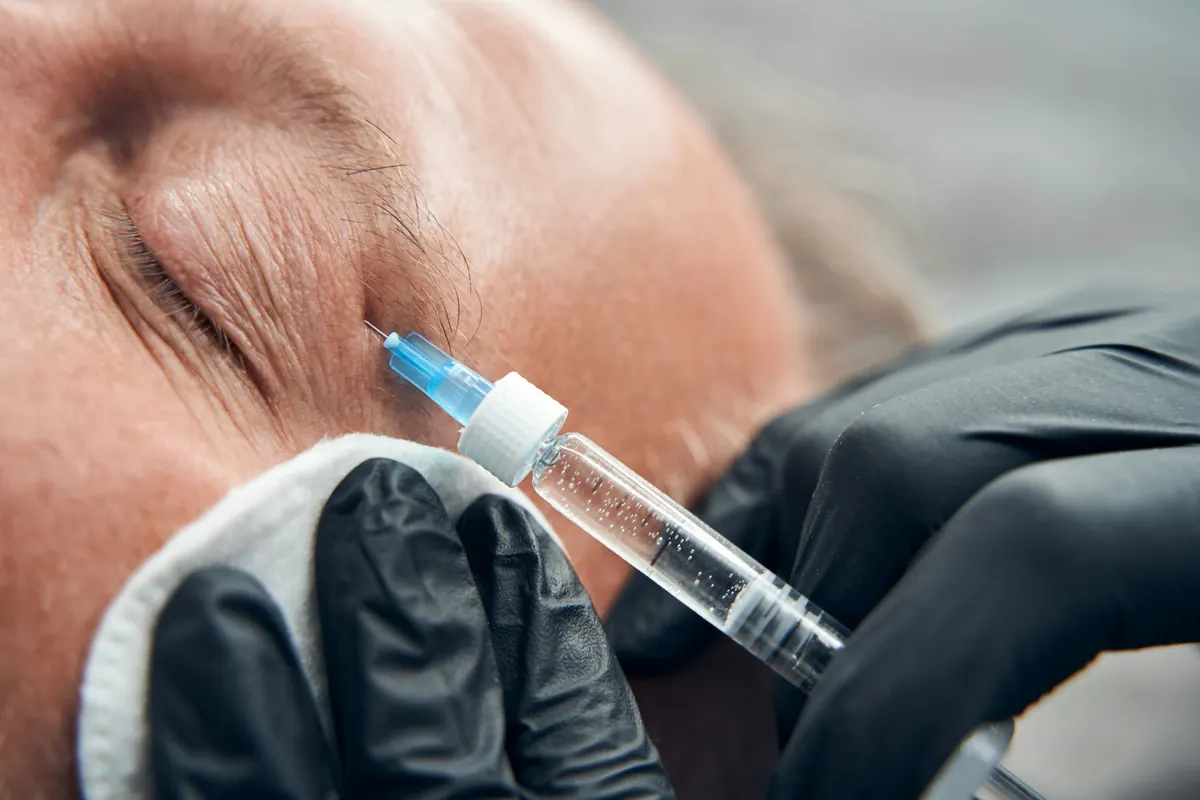
The lines that fan out from the outer corner of your eye when you smile are crow's feet, known clinically as lateral canthal lines. This is the best-evidenced treatment in the lower half of the eye area, and it is frequently the treatment a good injector will steer you towards instead of the one you asked for.
1. What crow's feet are, and the muscle behind them
Smile hard at a mirror. The lines radiating outward from the outer corner of each eye are crow's feet. They are produced by the orbicularis oculi, the ring of muscle that encircles the eye and closes the lid.
That word "ring" matters more than anything else in this article. The orbicularis oculi is a sphincter: a circular muscle that tightens like a drawstring. Treatment here does not target the whole ring. It targets only the lateral fibres, the outer arc sitting over the bony rim of the eye socket. The rest of the ring, including the part that lets you blink and close your eye properly, is deliberately left alone.
Understanding that the treatment is a slice of a ring rather than a whole muscle explains both why it is safe when done correctly and why it goes wrong when the injector strays inward or downward.
2. One of only four approved areas on the face
Botox Cosmetic is FDA approved for exactly four cosmetic areas. Crow's feet were the second, approved on 11 September 2013.
| Area | Approved | Labeled dose |
|---|---|---|
| Frown lines (glabella) | April 2002 | 20 units across 5 points |
| Crow's feet (lateral canthal) | September 2013 | 24 units total, 12 per side |
| Forehead lines | 2017 | 20 units frontalis plus 20 units glabellar complex |
| Platysma bands (neck) | October 2024 | 26, 31 or 36 units by band severity |
"Off-label" is not a warning. It is legal, common, and often the right clinical choice. But it means the dosing conventions come from practice and published experience rather than from trials submitted for approval, so your injector's individual judgement carries more weight. It is worth knowing which category you are in, and almost nobody tells you.
3. The labeled protocol, in full
Here is the protocol as the product labeling sets it out, because you will not find it on most clinic pages and it is the single most useful thing on this page:
- 24 units in total, split as 12 units per side.
- Each side receives 4 units into each of three sites, so six injection points across both eyes.
- The injections go into the lateral orbicularis oculi.
- The first point sits roughly 1.5 to 2.0 cm temporal to the lateral canthus, which is to say outward from the outer corner of the eye, and just temporal to the orbital rim, meaning outside the bony edge of the socket rather than over the eye itself.
- The needle is angled with the bevel tip up and pointed away from the eye.
How to use this. You are not going to measure centimetres at your appointment. But "how far out from the corner of my eye do you inject, and how do you stay off the orbital rim?" is a question a competent injector answers immediately and in those terms. Someone who has no answer is working from a memorised pattern rather than from anatomy.
In practice, doses between roughly 10 and 24 units in total are common, and lower is reasonable for fine lines or a first treatment. What should not vary is staying outside the bony rim.
4. Why 12 units here and 3 units a centimetre lower
This is the contrast that explains the whole eye region, and it is genuinely surprising the first time you see it side by side.
| Treatment | Dose per side | Why |
|---|---|---|
| Crow's feet | 12 units | Sits over the bony orbital rim. The muscle here holds nothing up, so relaxing it costs you nothing structurally. |
| Under the lower lid | 2 to 4 units | The muscle here supports the lower lid. Over-relax it and the lid can sag, and there is no reversal agent. |
So when an injector recommends crow's feet instead of the under-eye treatment you asked about, that is usually sound advice rather than avoidance. The approved area addresses much of what people dislike about the outer eye, at a dose with trial data behind it, in tissue where the downside of getting it slightly wrong is cosmetic rather than functional.
5. "Will I lose my smile?"
The most common fear, and the answer is reassuring but conditional.
Your smile is not produced by the orbicularis oculi. It comes mainly from the zygomaticus muscles, which lift the corners of the mouth, plus the risorius and others. Treating the lateral fibres of the eye ring does not touch those. You will still smile.
What can change is how your eyes participate. A genuine smile normally crinkles the outer eye, and if that crinkling is fully abolished the expression can read as slightly flat or less warm, even though the mouth is doing exactly what it did before. Some people want the lines gone entirely and are delighted. Others prefer a partial softening that keeps some movement.
That is a preference to state out loud before treatment, not after. "Soften them but keep some movement" is a normal and achievable request, and it usually means a lower dose.
The separate risk, where the smile genuinely is affected, comes from injecting too low or too far inward, where the toxin can reach the zygomaticus. That is covered in section 8.
6. The part Botox cannot fix, and it is bigger here
Relax your face completely and look at the outer corner of your eye. Lines still visible when nothing is moving are static lines, and Botox does not remove them.
Crow's feet are the area where this matters most, for two reasons. The skin at the outer eye is among the thinnest on the body, and it is one of the most sun-exposed areas on the face. So a large share of what people call crow's feet is photoaging: crepey texture, fine crosshatching, and loss of elasticity that has nothing to do with muscle at all.
Botox stops the folding, and over months the skin does soften once it is not being creased hundreds of times a day. But if your outer eye is crepey at rest, a neurotoxin alone will disappoint you, and being told otherwise is the main source of unhappy crow's feet patients. The realistic plan is Botox for the movement plus something that works on the skin itself: resurfacing, microneedling, or consistent sun protection going forward. Our Botox versus microneedling comparison covers how the two differ and why they are often used together rather than instead of each other.
7. What it costs at real published rates
Below is the crow's feet range against the actual per-unit prices published by clinics in the cities we verify, so you can see the real number for where you live.
| Published rate | Per unit | 10 to 24 units |
|---|---|---|
| Lowest we found | $9 | $90 to $216 |
| Middle of the range | $12 | $120 to $288 |
| Highest we found | $18 | $180 to $432 |
These are rates clinics actually publish, read off their own price pages rather than estimated: the floor is $9 a unit in Atlanta, GA and the ceiling $18 in Tampa, FL. Your own city may sit outside that range entirely. We check published pricing city by city, and the locations index lists every city covered so far, with the named clinics and their rates.
Crow's feet are often quoted as part of an upper-face package with the forehead and glabella, which is usually better value than three areas priced separately. Ask for both numbers. Our Botox price guide covers state averages and the per-unit versus per-area question.
8. What goes wrong, and why placement decides it
The complications here are almost entirely about where the needle went, not how much went in.
- Asymmetric or flattened smile. Injecting too low or too far inward lets toxin reach the zygomaticus. The corner of the mouth on that side lifts less. Temporary, but it lasts as long as the treatment does.
- Lower lid heaviness or worsened puffiness. Straying down towards the lid, into tissue that belongs to the under-eye discussion rather than this one.
- Bruising. Genuinely more common here than anywhere else on the face. The skin is thin and the area is rich in small superficial vessels. It is not a sign of poor technique, though avoiding blood thinners and alcohol beforehand reduces it. Our pre-Botox guide lists what to avoid and for how long.
- Lines simply shifting. Relaxing the outer fibres can make the remaining untreated fibres more noticeable, so a line appears slightly higher or lower rather than gone. Usually resolved with a small adjustment at the two-week review.
None of these are permanent, because there is no reversal agent and everything resolves as the toxin wears off. That cuts both ways: nothing here is forever, and nothing here can be undone on demand either.
9. How long it lasts
Roughly three to four months, with onset in a few days and the full effect at about two weeks, which is why the two-week review exists.
Crow's feet often fade a little sooner than the glabella. The dose per unit of muscle is modest and the orbicularis oculi is one of the busiest muscles you own, since you blink somewhere in the region of fifteen to twenty times a minute without thinking about it. A moderate dose in a constantly working muscle recovers faster. That is normal rather than a sign of resistance or a poor treatment.
10. What to ask before you agree
- How far out from the corner of my eye will you inject, and how do you stay clear of the orbital rim? The one question that separates anatomy from a memorised pattern.
- How many units per side, and why that number for me?
- Which of my lines are movement and which are skin? Ask them to show you in the mirror at rest and then smiling.
- Can you soften these but leave me some movement? If that is what you want, say so before, not after.
- Am I likely to bruise, and how long should I leave before an event?
- Is a two-week review included, and is a top-up charged separately?
And the check that costs nothing: confirm your injector holds a current license. The records are public and free. We list the lookup for every state in how to verify a Botox injector's license.
Closest to the eye, and yet. Despite being the injection nearest the eye, crow’s feet treatment does not list eyelid ptosis among its most common reactions. Why that is, and what to do if a lid does drop.
Every area Botox treats, and what each one takes
Botox is not one treatment, it is eight or so, and the dose ranges by a factor of thirty between the smallest and the largest. 4 of these areas are on the FDA label; the rest are off-label, which is legal and common but means the dose comes from clinical practice rather than from a registration trial.
| Area | Typical dose | FDA status |
|---|---|---|
| Frown lines (glabella) | 20 units | FDA approved |
| Forehead lines | 20 units, with the glabella | FDA approved |
| Crow's feet (you are here) | 24 units | FDA approved |
| Neck and platysmal bands | 26 to 36 units | FDA approved |
| Brow lift | 4 to 12 units | Off-label |
| Lip flip | 2 to 6 units | Off-label |
| Masseter (jaw slimming) | 40 to 60 units | Off-label |
| Under the eyes | 1 to 4 units per side | Off-label |
| Bunny lines (nose) | 2 to 5 units per side | Off-label |
| Gummy smile | 2 to 3 units per side | Off-label |
| Marionette lines | 2 to 8 units per side | Off-label |
Units are not comparable between brands, so these are Botox units. Full ranges per area are in the units guide and calculator.
Worth knowing before you book this area alone. In Xeomin’s trials, crow’s feet treated on their own succeeded in 24% of patients, against 33% to 53% when the whole upper face was treated at the same dose.
Frequently asked questions
How many units of Botox for crow's feet?
Is Botox FDA approved for crow's feet?
Will Botox for crow's feet change my smile?
Why do crow's feet get 12 units a side when the under-eye gets 3?
Will Botox get rid of crepey skin under my eyes?
How much does Botox for crow's feet cost?
Does crow's feet Botox bruise more than other areas?
How long does crow's feet Botox last?

Sources
Every figure on this page was read from the documents below rather than from a clinic or a manufacturer's marketing. They open in a new tab so you can check any claim here against its source.
- BOTOX Cosmetic prescribing information, FDA via DailyMed
- Botulinum toxin treatment overview, American Academy of Dermatology
Keep reading
 Botox Treatment AreasThe Botox Brow Lift
 Botox Treatment AreasBotox for Forehead Lines
 Botox Treatment AreasBotox for Frown Lines and the Glabella (the "11s")
 Botox Treatment AreasMasseter Botox for Jaw Slimming and Bruxism
 Botox Treatment AreasThe Nefertiti Lift and Neck Botox
 Areas and SafetyBotox Around the Eyes