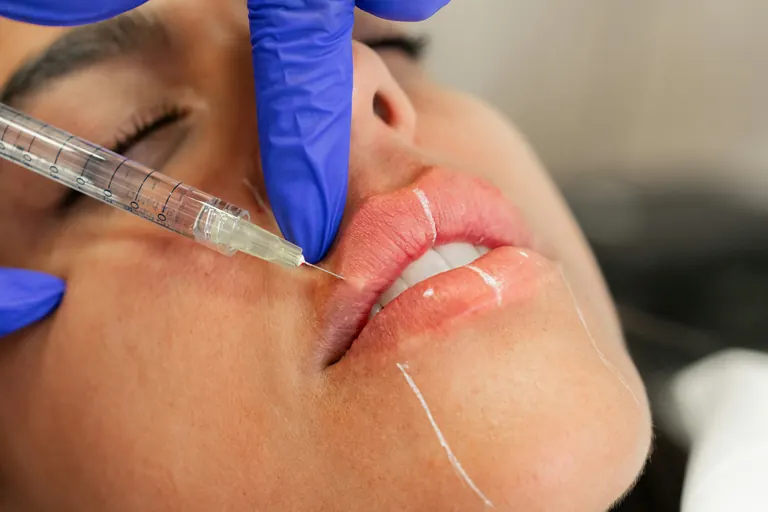
Pillow Face: Why It Happens to People Who Went to Good Clinics
Reviewed for medical accuracy against our Medical Review Board · Last updated 28 August 2026
Part of Dermal Fillers
Pillow face is usually arithmetic, not a bad injector. Patients are told hyaluronic acid filler lasts 6 to 12 months, so they top up on that cycle. In 2024 a study MRI-scanned 33 people who had mid-face filler and found it still present in every single one, with no complete disappearance at two years and detectable filler up to 15 years later. If the last round is still largely there when the next one goes in, the face is not being maintained. It is being accumulated.

That is the mechanism, and it explains the thing people find hardest to understand about pillow face: it happens gradually, to people who went to reputable clinics, without anyone making an obvious mistake. It even has a clinical name.
1. What pillow face actually is
Pillow face is the flattened, rounded, slightly inflated look that comes from too much filler in the mid face over time. The cheeks sit high and wide, the space under the eye fills out, the face reads as broader and less defined, and expression flattens because there is more volume sitting over the muscles that make it.
In the medical literature it is called facial overfilled syndrome, and a 2026 paper in Aesthetic Plastic Surgery describes it as "a complication of excessive hyaluronic acid filler use" that "poses challenges in aesthetic medicine due to its gradual onset and impact on facial contours".
The words that matter there are gradual onset. This is not an event. Nobody walks out of an appointment with pillow face. It arrives slowly enough that the person it is happening to is the last to see it, because they are comparing today with three months ago rather than with five years ago.
2. The MRI finding that explains it
The usual explanation for pillow face is that someone overdid it. The better explanation, and the one with imaging behind it, is that the filler did not leave.
In 2024 Plastic and Reconstructive Surgery Global Open published a review of MRI scans from 33 patients who had received hyaluronic acid filler in the mid face. Two blinded radiologists assessed the scans. What they found:
- Filler was present in all 33 patients. Not most. All of them.
- No complete dissipation was observed over a two year period.
- 21 of them had not had an injection for 2 to 5 years. Twelve had not had one for over 5 years. Some had not been injected for 8 to 15 years.
- The paper reports HA longevity up to 15 years across different products.
- The amount still present was graded mild in 9 patients, moderate in 13 and severe in 11.
The authors put it plainly: the evidence "challenges the conventional belief that hyaluronic acid fillers have a short lifespan of 3-12 months" and "suggests a need to reconsider refilling protocols".
This is the whole page in one line. The 6 to 12 month figure you were quoted describes how long the visible effect lasts, not how long the material stays in your face. Those are different questions, and only one of them is usually answered.
To be fair to the number: it is not a lie. Filler is broken down and it does lose volume, and the cosmetic result genuinely does soften on roughly that timeline. But softening is not disappearing, and the difference between the two is what accumulates.
3. The arithmetic of a yearly top-up
Put the two facts together and pillow face stops being mysterious.
Someone has 2ml in the cheeks. At a year it looks softer, so they have 2ml more. If the first 2ml were gone, they would be back where they started. If most of it is still there, which the MRI data says is likely, they are now carrying appreciably more than 2ml. Repeat annually for eight years and the total injected is 16ml, of which an unknown but clearly non-trivial share is still in the face.
Nobody in that sequence did anything obviously wrong. Each individual treatment was reasonable, each one produced a result the patient liked, and the interval was the one they were told to use. The problem is only visible in aggregate, and the person best placed to see it is looking in the mirror every day, which is the worst possible vantage point for noticing gradual change.
This is also why photographs matter more here than anywhere else in aesthetics. The 2024 paper makes exactly that point, underscoring "the critical role of precise clinical photography for accurate comparisons". A clinic that photographs you consistently at each visit can show you the five-year comparison. One that does not, cannot.
4. Why it looks worse than the volume injected
Hyaluronic acid is hygroscopic, meaning it binds water. That is not a side effect, it is the mechanism: the gel draws and holds water, and the water is part of the volume you paid for.
Two consequences. The volume in your face is larger than the volume in the syringe. And it varies, because water content is not constant, which is part of why some people look puffier at some times than others and why the area around the eye is where it is noticed first.
The eye area also produces the delayed problems. A 2026 case report describes a woman with persistent upper eyelid swelling that turned out to be hyaluronic acid, confirmed on histology after surgery. She had been injected in the temples two years earlier and only remembered it after the operation. The authors describe the case as illustrating "the resilience and migration potential" of HA fillers, particularly in areas where the material can move along tissue planes.
If you have unexplained facial swelling and have ever had filler, the filler is worth mentioning to whoever is investigating it, however long ago it was. On this evidence, "years ago" does not rule it out.
5. How to tell it is happening to you
The reliable checks are the ones that do not rely on your memory of how you used to look:
- Photographs from five or more years ago, in similar light and at a similar angle. Not last year's. The change is slow enough that a one year comparison shows almost nothing.
- Smile in a mirror and watch the mid face. Overfilled cheeks tend to push upward and outward on smiling in a way that reads as separate from the smile itself.
- Look at the space under the eye in daylight from the side. Fullness that is present at rest, does not change with expression, and looks slightly translucent or bluish is a filler pattern rather than a fat pattern.
- Count the years, not the millilitres. Most people cannot recall total volume, but almost everyone can say "about once a year since 2019", and given the MRI findings that is the number that matters.
One honest caveat. Faces change with age on their own, and some of what looks like overfilling is descent of tissue that was always there. A practitioner who did not do the original work is better placed to give you a straight answer than the clinic that has been treating you throughout.
6. Dissolving it, and what the evidence says
Unlike a neurotoxin, hyaluronic acid filler can be removed. Hyaluronidase is an enzyme that breaks it down, it works within days, and it is the reason HA is the default filler material rather than the permanent alternatives.
The 2026 Aesthetic Plastic Surgery study treated 50 patients with facial overfilled syndrome using hyaluronidase and measured the result with 3D photography and MRI volumetry. Both groups improved on the Global Aesthetic Improvement Scale, and the volume reductions were substantial: one reported figure took a forehead from 31.6ml to 7.9ml at two months.
Points worth knowing before you have it done:
- It is not perfectly selective. Hyaluronidase acts on hyaluronic acid, and your own tissues contain hyaluronic acid. Most practitioners describe a period of looking deflated or older before things settle.
- It may take more than one session, particularly where filler has been layered over years and sits in more than one plane.
- Allergic reaction is possible, since it is an enzyme, and it is the reason it should be given somewhere equipped to manage that.
- You may not want all of it gone. Dissolving is a blunt instrument, and going from overfilled to hollow in a week is its own problem.
Our filler complications page covers hyaluronidase in its emergency role, where it is used urgently for a blocked blood vessel. That is a different use of the same drug and a genuine emergency, not a cosmetic decision.
7. Do you need MRI-guided dissolving?
Some clinics now offer MRI to map exactly where filler sits before injecting hyaluronidase, at obvious extra cost. The 2026 study tested precisely this, comparing 25 patients treated with 3D MRI guidance against 25 treated without.
The guided group did get accurate localisation of the filler. But on the outcome that matters, there was no significant difference: Global Aesthetic Improvement scores were 1.62 with guidance and 1.68 without, with p greater than 0.05, and adverse events were comparable.
So on the current evidence, MRI guidance is interesting but has not been shown to produce a better cosmetic result than an experienced practitioner working without it. If it is offered to you as a paid upgrade, that is a fair thing to ask about. One study of 50 people is not the last word, and it may matter more in complex or repeatedly treated faces, but nobody should imply the benefit is established.
8. How to not end up here
Six things that prevent it
- Ask how much is already in there before adding more. The single most useful question, and the one the MRI data justifies. "How much have I had in total, and how much of it do you think is still present?"
- Insist on standardised photographs at every visit. The 2024 paper singles this out. Without them, neither of you can see a five year trend.
- Treat the 6 to 12 month figure as being about the look, not the material. A softened result is not an empty face, and it is not automatically a reason to refill.
- Consider skipping a cycle rather than topping up on schedule. If filler persists for years, an annual appointment is a convention rather than a clinical necessity.
- Be wary of treating each area in isolation. Pillow face is a whole-face outcome produced by sensible-looking individual decisions.
- Check who is injecting you and what they hold. It takes two minutes with our licence verification guide.
The reassuring part is that this is the most reversible problem in aesthetics. It can be dissolved, the enzyme is cheap and quick, and the evidence shows real volume coming back out. The unreassuring part is that almost nobody is told the filler is still there, so the decision to add more gets made without the one fact that would change it. Our Botox versus fillers guide covers the wider difference between a drug that wears off and a material that stays.
Frequently asked questions
What causes pillow face?
How long does filler really last?
Can pillow face be reversed?
Is MRI-guided filler dissolving worth paying for?
How do I know if I have too much filler?
Can old filler cause problems years later?
Sources
Every figure on this page was read from the documents below rather than from a clinic or a manufacturer's marketing. They open in a new tab so you can check any claim here against its source.
- Hyaluronic Acid Filler Longevity in the Mid-face: A Review of 33 MRI Studies, Plastic and Reconstructive Surgery Global Open, 2024
- 3D MRI-Guided Localization of Hyaluronic Acid Hydrogel for Precision in Hyaluronidase Injection, Aesthetic Plastic Surgery, 2026
- Late-Onset Upper Eyelid Edema Following Temporal Hollow Correction With Hyaluronic Acid, Plastic and Reconstructive Surgery Global Open, 2026
- Dermal fillers (soft tissue fillers), US Food and Drug Administration

Know the count before the quote. The unit count is half the bill, and a low per-unit rate recovered by a high unit count is the commonest way a deal is not one. How to tell.
Deciding which area, not how many units? Botox by facial area covers what each zone actually achieves, which four are FDA approved, and the things Botox cannot fix at all.