
The Ultimate Xeomin Guide
Reviewed for medical accuracy against our Medical Review Board · Last updated 23 August 2026
Part of Botox vs Other Brands
Nearly every page about Xeomin, including four statements on this site before we checked, says it is approved only for frown lines. That has stopped being true. The current label approves Xeomin for three cosmetic areas: frown lines at 20 units, horizontal forehead lines at 20, and crow's feet at 24, up to a maximum of 64 units when all three are treated together. And its frown line dose is 20 units, exactly the same as Botox Cosmetic's, which means a Xeomin price per unit is one of the few that can be compared with a Botox price per unit directly.
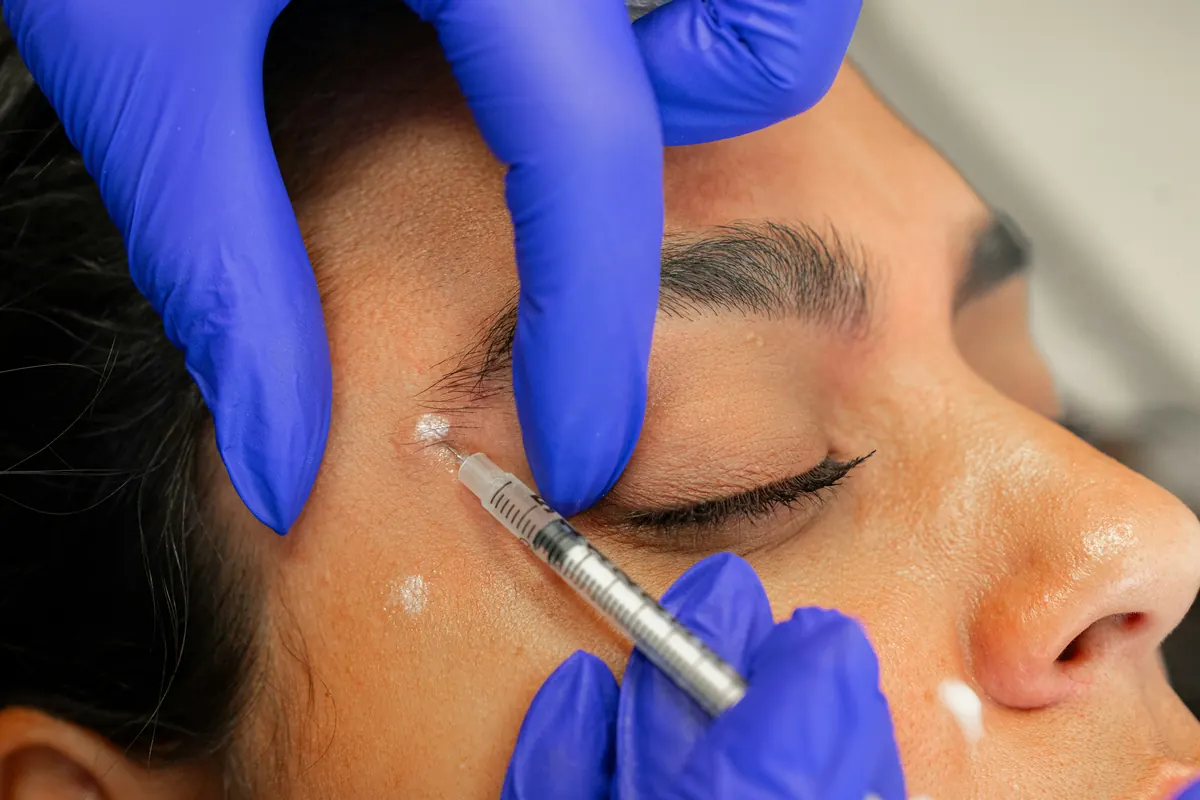
Everything here comes from the prescribing information as published by the FDA, effective 10 July 2026. Where the internet and the label disagree, we say so and show the label.
1. What Xeomin is
Xeomin is a botulinum toxin type A product made by Merz. Its generic name is incobotulinumtoxinA, and it does the same thing as every product in this class: it blocks the release of acetylcholine at the nerve ending, so the muscle it was instructing stops contracting as hard. Movement returns as the nerve forms new endings.
What makes it distinctive is what has been taken out. The label describes the active neurotoxin being separated from the accessory proteins it is produced with, the hemagglutinins and non-hemagglutinins, leaving a 150 kDa neurotoxin "without accessory proteins". That is the label's own phrase, and it is where the marketing nickname comes from.
Each vial contains the toxin plus human albumin (1 mg) and sucrose (4.7 mg), and it comes in 50, 100 and 200 unit single-dose vials. The 200 unit vial is the largest in this class.
2. What it is approved for, including the part everyone gets wrong
Xeomin holds more FDA approvals than most people realise, and its cosmetic indication is wider than almost every article about it admits.
| Indication | Population |
|---|---|
| Glabellar lines (frown lines) | Adults |
| Horizontal forehead lines | Adults |
| Lateral canthal lines (crow's feet) | Adults |
| Chronic sialorrhea (excessive drooling) | 2 years and older |
| Upper limb spasticity | 2 years and older |
| Cervical dystonia | Adults |
| Blepharospasm | Adults |
The three cosmetic areas matter enormously for anyone comparing brands, because it puts Xeomin ahead of Dysport on labelled cosmetic coverage. Dysport is approved for the glabella and nothing else, so a Dysport forehead treatment is off-label with no published dose, as our page on Dysport treatment areas sets out. A Xeomin forehead treatment is on-label with a dose the FDA reviewed.
Two honest caveats. Off-label use is legal, routine and often excellent, so this is not a safety ranking. And Botox holds medical approvals Xeomin does not, including chronic migraine and excessive underarm sweating, covered in our page on therapeutic uses.
3. The labelled doses
Because all three areas are approved, all three have doses a regulator signed off, which is rare in aesthetics.
| Area | Dose | Injection pattern |
|---|---|---|
| Glabellar lines | 20 units | 4 units into each of 5 sites |
| Horizontal forehead lines | 20 units | 4 units into each of 5 sites |
| Forehead and glabella together | 40 units | 20 in each area |
| Lateral canthal lines | 24 units | 4 units into each of 3 sites per side |
| All three areas together | 64 units maximum | 20 glabella, 20 forehead, 24 crow's feet |
Retreatment should be no more frequent than every three months. If you are quoted a total that differs sharply from these figures, that is not automatically wrong, since injectors adjust to your anatomy, but it is a reasonable thing to ask about.
4. Why Xeomin units compare to Botox units and Dysport's do not
This is the single most useful practical fact about Xeomin, and it takes one paragraph to explain.
Every botulinum toxin label says the same thing: units are specific to that product's own assay and cannot be converted into another product's units. Xeomin's label says it, Botox's says it, Dysport's says it. But labels also give doses, and comparing the doses for one identical indication tells you what the manufacturers themselves think:
| Product | Labelled glabellar dose | Implied ratio to Botox |
|---|---|---|
| Botox Cosmetic | 20 units | 1 |
| Xeomin | 20 units | about 1 to 1 |
| Dysport | 50 units | about 2.5 to 1 |
So when a clinic charges $11 a unit for Xeomin and $13 for Botox, that is a genuine saving of roughly 15% on the same treatment. When a clinic charges $11 a unit for Dysport against $13 for Botox, it is usually not a saving at all, because it takes about two and a half times the units. Our guide to Dysport units against Botox units works that trap through in detail.
Put simply: a Xeomin discount is usually real. A Dysport discount usually is not. Ask for the total either way, but with Xeomin the per-unit number is at least meaningful.
5. The "naked toxin", and what it does and does not mean
The removal of accessory proteins is real and it is in the label. What is claimed about it usually is not.
The theory is that fewer foreign proteins means less chance your immune system produces antibodies that stop the treatment working. It is biologically plausible. Here is what the label actually reports:
- Of 2,649 patients treated in clinical trials, 0.3% were positive for neutralising antibodies after treatment, plus a further 0.2% who developed them.
- No patient lost response to treatment because of neutralising antibodies.
That is reassuring. What it does not do is prove Xeomin is better than the others on this, and the label is explicit about why: differences in assay methods "preclude meaningful comparisons" of antibody rates between studies and products. Dysport's label separately reports zero neutralising antibodies across 1,554 cosmetic patients treated up to nine times, which is at least as good a number.
So the honest position is that antibody resistance is not a practical problem with any modern cosmetic toxin at cosmetic doses, and the naked toxin is a fair talking point rather than a demonstrated advantage. If a clinic tells you Xeomin is the only one that will not stop working, they are overstating the evidence. The brand comparison covers where the real differences sit.
6. How well it works, by area
Two trials, 1071 and 1070, treated 730 adults and measured success at day 30 on a demanding endpoint: a score of none or mild, plus at least a two grade improvement, plus agreement between the investigator and the patient.
| Area | Trial 1071, all three areas | Trial 1070, all three areas | Placebo, both trials |
|---|---|---|---|
| Glabellar lines | 53% | 49% | 0% |
| Horizontal forehead lines | 67% | 58% | 0% |
| Lateral canthal lines | 53% | 33% | 0% |
Two things stand out, and neither appears anywhere else we can find.
First, the forehead responded best, at 58% and 67%, better than the glabella in both trials. That is counterintuitive, since the glabella is the area everyone treats first and the one all the marketing is built around. If you are choosing one area to start with on results alone, the data points at the forehead. Our page on forehead lines covers what the treatment actually does there, including why the brow can drop if the frown muscles are left alone.
Second, placebo success was zero. Not low: zero, in every area of both trials, on several hundred patients. Whatever else is arguable about brand differences, that this class of drug works is not.
The flip side is that roughly half of people did not meet that bar even on the drug. They mostly improved, just not by two full grades with both assessors agreeing. Somewhere between a third and a half of people get a more modest result than a clinic's photo wall implies, and the photos are not fake, they are the top of the distribution.
7. The crow's feet finding
This one is worth its own section because it changes what you should book.
In trial 1070, one group had only their crow's feet treated, at the full labelled 24 units. Their success rate was 24%. In the same trial, patients who had crow's feet treated as part of all three areas succeeded at 33%, and in trial 1071 at 53%.
Same dose, same area, very different outcomes depending on what else was treated. The label does not explain why, and we are not going to invent a mechanism. The plausible readings are that the muscles around the eye work with the brow and forehead so treating one in isolation fights the others, or that an isolated improvement is simply harder for a patient to perceive as a two grade change when the rest of the face is unchanged.
The practical version: crow's feet alone is the weakest treatment on the label, and if crow's feet are your main concern it is worth discussing treating the upper face together rather than that area on its own. See crow's feet for what the treatment can and cannot do there, and note the general rule that lines visible when your face is completely still are creases in the skin, which no toxin removes at any dose.
8. Onset, duration and the three month rule
Xeomin's label is more forthcoming here than most, and more than Dysport's. Section 2.9 states that the median onset of effect occurs within two to seven days, and that the typical duration of each treatment is up to 12 to 16 weeks, while adding that duration may vary between individuals. Efficacy was measured at day 30 in all four cosmetic trials, and retreatment should be no more frequent than every three months.
Twelve to sixteen weeks is three to just under four months, and "up to" means the top of the range rather than the average. This is the one timing question where Xeomin is better documented than Dysport, whose label gives no onset figure at all despite its stronger reputation for working quickly. Our page on how long Xeomin lasts goes through both figures and what actually moves them.
Claims that Xeomin outlasts Botox are not established by either label, and the two are generally comparable. Dysport's nominal ceiling of four months is marginally higher on paper, but its own day-by-day data shows only about one patient in five still clear at day 120.
9. The refrigeration difference
A small fact with real consequences: unopened Xeomin vials do not need refrigerating. The label says to store them at or below 25 degrees Celsius, and that refrigeration of unopened vials is not required. Botox and Dysport both require cold storage from the moment they arrive.
Two things follow. Clinics can stock Xeomin without cold-chain handling, which is part of why smaller practices carry it. And there is one fewer point at which the product can be mishandled before it reaches you.
Once reconstituted, the rules tighten to match the others: refrigerated at 2 to 8 degrees, used within 24 hours, one injection session, one patient.
10. Side effects, contraindications and the boxed warning
Xeomin carries the same boxed warning as every botulinum toxin product, about effects spreading from the injection site to cause swallowing and breathing difficulties, which can be life threatening and have been reported hours to weeks after injection. The risk concentrates in therapeutic dosing rather than in a 20 unit cosmetic treatment, but the symptoms are worth knowing: trouble swallowing, breathing or speaking, muscle weakness away from the injection site, or new drooping of an eyelid or double vision. Those need medical attention rather than a wait-and-see.
Contraindications are short: known hypersensitivity to any botulinum toxin product or to any component of the formulation, and infection at the injection site.
One genuinely useful difference here. Xeomin contains human albumin and sucrose. It contains no lactose, so it carries no cow's milk protein contraindication. Dysport does, because it may contain trace milk protein. If you have a diagnosed cow's milk protein allergy, Xeomin is available to you and Dysport is not.
11. The medical uses
Xeomin's medical approvals are broader than its reputation suggests, and one is unusual.
Chronic sialorrhea, meaning excessive drooling, in patients aged two and over. The adult dose is 100 units per session, split between the parotid and submandibular glands on both sides in a 3:2 ratio. This is a genuinely life-changing treatment for some people with neurological conditions, and it is not something Botox is approved for.
Upper limb spasticity in patients two and over, cervical dystonia in adults, and blepharospasm in adults, the involuntary eyelid closing that can be severe enough to be functionally blinding.
What Xeomin is not approved for, and where Botox is: chronic migraine, and excessive underarm sweating. If either of those is what you are treating, the brand matters and Botox is the one with the reviewed protocol.
12. What it costs
Across the eighteen cities where we have read clinics' own published price lists, Xeomin is typically priced at or slightly below the same clinic's Botox rate. Two examples from our city research: Medical Aesthetics in Charleston publishes $13 a unit for Botox and $11 for Xeomin, and a Nashville clinic publishes Xeomin at $12 against Botox at $14.
Because the units are roughly one to one for the glabella, those are real savings of about 15% and 14% on the same treatment. That is the whole reason Xeomin is worth asking about: it is the discount that survives the arithmetic.
Our city guides list named clinics and their own published rates for every city we have covered, and the Botox price guide covers what drives the spread.
13. When Xeomin is the right choice
Good reasons to choose it:
- You want the forehead or crow's feet treated on-label, with a dose a regulator reviewed, rather than off-label as with Dysport.
- Your clinic prices it below its Botox rate, in which case the saving is real because the units are comparable.
- You have a cow's milk protein allergy, which rules out Dysport.
- You want all three upper facial areas treated in one session, which the label covers explicitly at up to 64 units.
Reasons that are weaker than they sound:
- "It has no proteins so it will not stop working." Plausible, not demonstrated, and the label forbids the cross-brand comparison that claim depends on.
- "It lasts longer." Not established by either label.
- "It is purer, so it is safer." It carries the same boxed warning and a comparable side effect profile.
When to choose something else: if you are treating chronic migraine or excessive sweating, Botox holds those approvals and Xeomin does not. And for anything around the mouth or on the masseter, all the brands are off-label and the choice comes down to your injector's judgement rather than the label. Whoever injects you matters more than which of these you pick, which is why it is worth checking their licence first.
Against the other main alternative. Xeomin against Dysport puts the two labels side by side: three approved cosmetic areas against one, 20 units against 50, and the cow’s milk contraindication that applies to only one of them.
The pricing in detail. Botox Cosmetic and Xeomin specify the same labelled doses for all three areas, 20, 20, 24 and 64 for the set, which is why the discount survives the arithmetic. Xeomin units and what it costs has the published rates and the per-area totals.
The safety data in full. Xeomin side effects has every rate with its placebo comparison, why those rates cannot be read against Dysport’s, and the boxed warning clause that is specific to Xeomin.
Frequently asked questions
What is Xeomin?
What is Xeomin approved for?
Is Xeomin approved for the forehead?
How many units of Xeomin do I need?
Is Xeomin the same as Botox in units?
Is Xeomin cheaper than Botox?
Does Xeomin work better than Botox?
Does Xeomin last longer than Botox?
Can you build immunity to Xeomin?
Does Xeomin need to be refrigerated?
Why did my crow's feet treatment not work as well as expected?
Can I have Xeomin if I am allergic to milk?
Is Xeomin used for migraines or sweating?

Sources
Every figure on this page was read from the documents below rather than from a clinic or a manufacturer's marketing. They open in a new tab so you can check any claim here against its source.
- Xeomin prescribing information, FDA via DailyMed
- BOTOX Cosmetic prescribing information, FDA via DailyMed
- OnabotulinumtoxinA injection, MedlinePlus, US National Library of Medicine
Know the count before the quote. The unit count is half the bill, and a low per-unit rate recovered by a high unit count is the commonest way a deal is not one. How to tell.
Deciding which area, not how many units? Botox by facial area covers what each zone actually achieves, which four are FDA approved, and the things Botox cannot fix at all.
Keep reading
 Other NeurotoxinsHow Long Does Xeomin Last?
 Other NeurotoxinsXeomin Units and What It Costs
 Other NeurotoxinsXeomin Side Effects
 Botox Comparison GuidesBotox vs. Xeomin
 Other NeurotoxinsXeomin vs Dysport
 Other NeurotoxinsJeuveau
 Other NeurotoxinsLetybo vs Every Other Neurotoxin
Botox BasicsWhat Botox Is Made Of
Other NeurotoxinsLetybo vs Every Other Neurotoxin
Botox BasicsWhat Botox Is Made Of
 Other NeurotoxinsXeomin Treatment Areas
Other NeurotoxinsHow to Pronounce Xeomin
Other NeurotoxinsXeomin Treatment Areas
Other NeurotoxinsHow to Pronounce Xeomin
 Other NeurotoxinsWhere to Get Xeomin