SKINVIVE for Neck Lines: What the FDA Trial Actually Found
Reviewed for medical accuracy against our Medical Review Board · Last updated 26 August 2026
Part of SKINVIVE by Juvederm
On 11 June 2026 the FDA approved SKINVIVE by Juvederm for reducing neck lines, its second indication. The approval rests on one pivotal trial of 159 people, and the trial found something the marketing will not tell you: nearly nine in ten participants had an injection site reaction, and almost a third of those lasted between two and four weeks.
This page is built entirely from the FDA's Summary of Safety and Effectiveness Data for P110033/S099. Where a number appears here, it is from that document.
1. What was approved, exactly
The indication, quoted from the approval:
SKINVIVE by JUVEDERM injectable gel is indicated for intradermal and/or subdermal injection to reduce neck lines for improvement of neck appearance in adults over the age of 21.
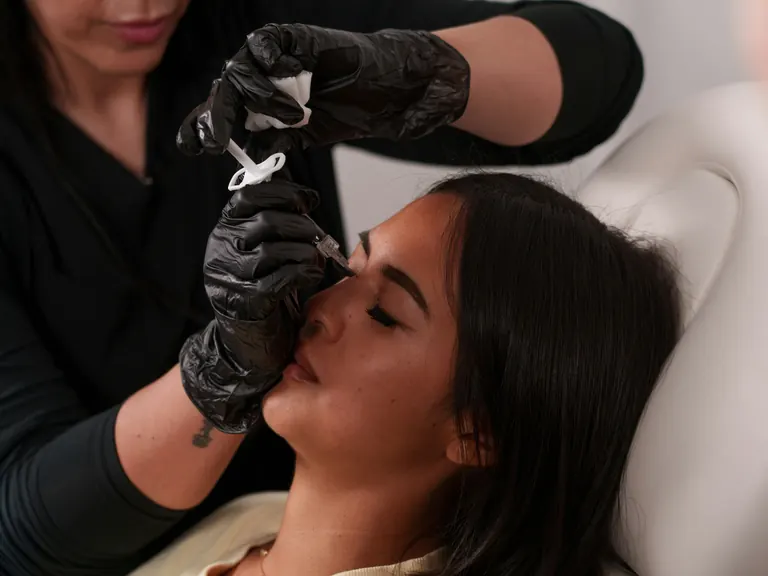
The supplement also approved a specific cannula for the job, the TSK 25 gauge one-and-a-half inch STERiGLIDE, used with a needle. Injection techniques used in the trial were microdroplet, tunneling and fanning, with a needle or a needle and cannula.
The trial defined the treatment area anatomically, and it is worth knowing because it tells you what was actually studied:
The studied area. Bounded above by a horizontal line along the hyoid bone, which is roughly where the neck meets the underside of the jaw. Bounded below by the sternal notch and the collarbones. Bounded at the sides by vertical lines dropped from the front of each ear. Anything outside that box was not part of the approval.
2. The trial, in plain terms
| Element | Detail |
|---|---|
| Design | Multicentre, evaluator-blind, randomised, no-treatment controlled |
| Participants | 159 randomised across 13 sites |
| Split | 2 to 1: 105 treated, 54 no-treatment control |
| Who qualified | Age 22 or over, with moderate or severe transverse neck lines, grade 2 or 3 on the Allergan Transverse Neck Lines Scale |
| Treated between | 2 May 2022 and 27 February 2024 |
| Extras allowed | Optional touch-up at day 30, optional repeat at month 6 |
Two features of that design change how you should read the results. The evaluator was blinded but the participants obviously were not, since one group was injected and the other was not. And the control group received no treatment at all rather than a sham injection, so nothing in this trial separates the product from the experience of having a needle put in your neck by a clinician who is paying attention to you.
3. Does it work? The number and the honest number
The primary endpoint was the proportion improving by at least one grade on the neck lines scale at month 1, judged by a blinded evaluator in person.
| Analysis | Treated | No-treatment control | Difference |
|---|---|---|---|
| ITT, with imputation | 74.8% (78.5/105) 95% CI 66.2 to 83.4 | 16.1% (8.7/54) 95% CI 5.7 to 26.5 | 58.7 points p < 0.0001 |
| Observed data | 76.8% (73/95) | 14.6% (7/48) | 62.3 points |
16.1% of people who had nothing done were rated improved by a blinded evaluator. That is the number to hold onto. It is not a criticism of the product, it is how these scales behave: lighting varies, posture varies, and a one-grade change on a four-point scale is a fine judgement. The drug's contribution is the gap, 58.7 points, which is large and clearly real.
Secondary endpoints pointed the same way. On the FACE-Q neck questionnaire the treated group averaged 70.2 at month 1, a mean improvement of 25.7 from baseline. On the investigator's global aesthetic improvement scale, 85.8% of treated participants were responders against 14.9% of controls. Participants rated themselves improved 89.4% of the time.
4. The touch-up nobody mentions
102 of the 148 treated participants, about 69%, took the optional touch-up at day 30. Every headline figure in this trial is reported as being "after initial or optional touch-up treatment". So the 74.8% success rate is not the result of one appointment. For roughly two thirds of those people it is the result of two.
That has a direct consequence for what you pay. If a clinic quotes you a single session price and the realistic path to the advertised result is two sessions a month apart, the real cost is close to double. Ask before you book, not after the first appointment.
A further 46 participants went on to have the optional repeat treatment at month 6. Responder rates after repeat treatment stayed above 88.1%, so it does appear to build, but that is a third appointment inside seven months.
5. How long it lasts
| Timepoint | Still improved |
|---|---|
| Month 1 | 76.8% |
| Month 2 | 78.0% |
| Month 4 | 75.0% |
| Month 6 | 66.0% (64/97) |
It holds up well to four months and then begins to slide. Two thirds were still responding at six months, which makes this a roughly twice-yearly treatment if you want to stay at the result you paid for. Anyone quoting you a year is not quoting the trial.
6. The downtime claim does not survive the data
Participants kept a 30 day diary after each treatment and rated each reaction none, mild, moderate, which the diary defined as uncomfortable, or severe. 147 of 148 completed it.
| Measure | Result |
|---|---|
| Had any reaction | 89.8% (132/147) |
| Mild | 42.9% (63/147) |
| Moderate, "uncomfortable" | 42.2% (62/147) |
| Severe | 4.8% (7/147) |
| Lasted 3 days or less | 6.1% (9/147) |
| 4 to 7 days | 22.4% (33/147) |
| 8 to 14 days | 24.5% (36/147) |
| 15 to 30 days | 29.3% (43/147) |
| More than 30 days | 7.5% |
Nine in ten had a reaction. Fewer than one in fifteen was clear within three days. Nearly a third were still dealing with something two to four weeks later, and one in thirteen beyond a month. The reactions are the usual list for an injectable: redness, bruising, tenderness, lumps and bumps, swelling, firmness, pain, discoloration and itching.
Keep two categories apart, because they are easy to conflate. Those injection site reactions were near universal and mostly resolved on their own. Treatment-related adverse events, the more serious category, were uncommon: five of 148 participants. The serious risks common to all fillers, including vascular occlusion, are covered on the filler complications page, and they are the reason to care who injects you. See verifying an injector's licence.
7. Not the same as neck bands
Two different neck problems get confused constantly, and they have different treatments:
- Horizontal lines across the neck, present when you are still. Skin and crease problem. This is what the SKINVIVE approval addresses.
- Vertical cords that stand out when you tense, the platysmal bands. Muscle problem. Treated with botulinum toxin, which has its own FDA-labelled dose for it, and is covered on the platysmal bands page.
A gel placed in the dermis will not relax a muscle, and a toxin will not soften a static crease. If your neck concern is the cords, this is the wrong product, and a clinic that does not draw the distinction is not assessing you carefully.
8. What to ask
- Is the touch-up included? About 69% of trial participants had one at day 30 and the published success rates depend on it.
- What is the six-month plan and cost? Two thirds were still responding at month 6, which is the real retreatment interval.
- What downtime should I actually expect? If you are told none, the answer is at odds with a trial where 29.3% had a reaction lasting two to four weeks.
- Are my lines static or dynamic? If they only appear when you tense, ask why this product and not a toxin.
- Needle, cannula, or both? The approval covers a needle and specifically the TSK 25 gauge STERiGLIDE cannula used with a needle.
The wider product, the cheek indication and how it compares with ordinary fillers and with toxin are covered on the main SKINVIVE page, and the dermal fillers guide puts it in context with the volumising products.
Frequently asked questions
Is SKINVIVE approved for the neck?
How well does SKINVIVE work on neck lines?
How long does SKINVIVE last on the neck?
Does SKINVIVE on the neck have downtime?
Will I need more than one appointment?
Is SKINVIVE better than Botox for the neck?
How much does SKINVIVE for the neck cost?
Which part of the neck was actually studied?

Sources
Every figure on this page was read from the documents below rather than from a clinic or a manufacturer's marketing. They open in a new tab so you can check any claim here against its source.
- Dermal fillers (soft tissue fillers), US Food and Drug Administration
- Premarket Approval (PMA) database, US Food and Drug Administration
Know the count before the quote. The unit count is half the bill, and a low per-unit rate recovered by a high unit count is the commonest way a deal is not one. How to tell.
Deciding which area, not how many units? Botox by facial area covers what each zone actually achieves, which four are FDA approved, and the things Botox cannot fix at all.