Botox for Men: The Multiplier Everyone Quotes Is Not in the Label
Reviewed for medical accuracy against our Medical Review Board · Last updated 2 September 2026
Part of Botox Guides: Basics, Dosing and Safety
The short version. The figure you will be quoted, that men need 1.5 to 2 times more Botox than women, is not in the FDA label. Neither is 20 to 30 per cent, or 125 to 150 per cent, which are the other two versions in circulation. The label sets one dose per approved area and makes no adjustment for sex at all.
That does not make the convention wrong. Larger muscles plausibly need more drug. It means the number is practitioner experience rather than trial data, and it is worth knowing which one you are being charged for.
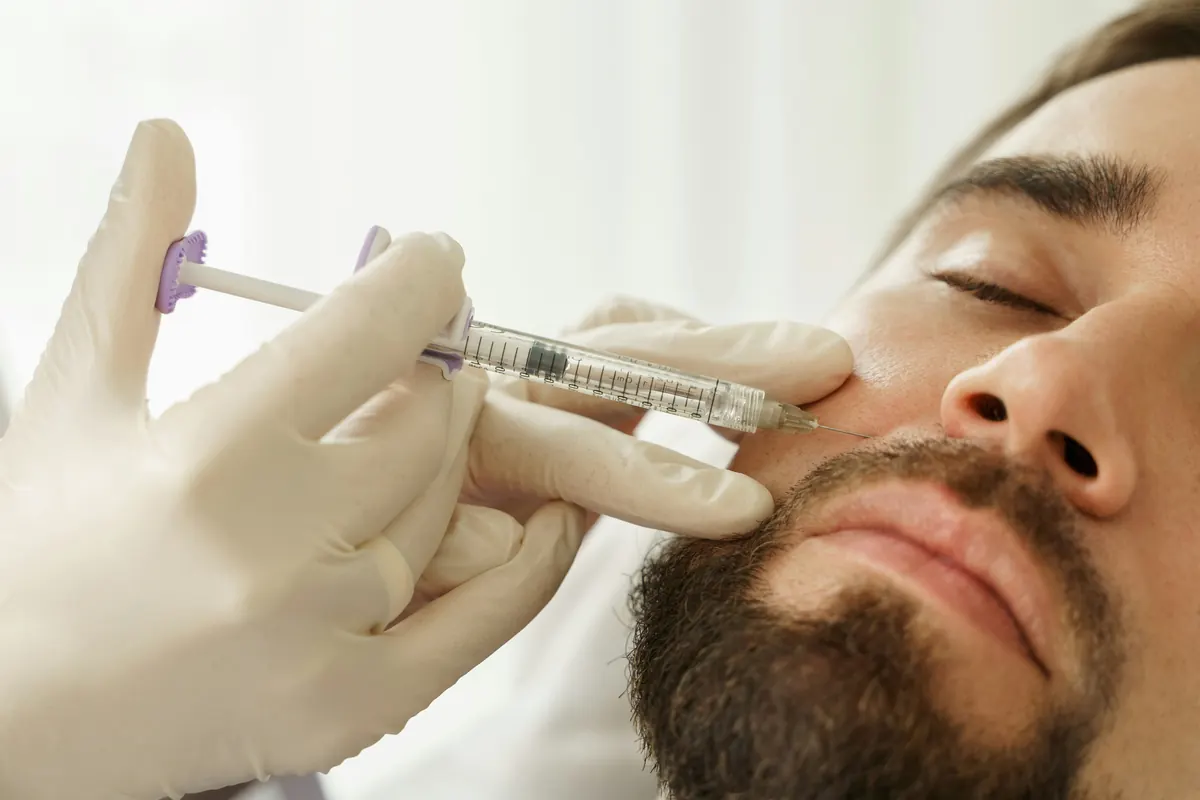
1. Three different multipliers, none of them from the label
Search for how much Botox a man needs and you will be given a multiplier. The trouble is which one. The same sites publish 1.5 to 2 times a woman's dose, 20 to 30 per cent more, and 125 to 150 per cent of a female dose, sometimes on different pages of the same site. Those are not the same claim. On a 20 unit frown line dose, 20 per cent more is 24 units and twice as much is 40 units, which at a typical rate is the difference between about $240 and about $400 for one area.
None of the three appears in the prescribing information. I checked the full BOTOX Cosmetic label, and the only place the word "male" occurs is a rat fertility study in the non-clinical toxicology section. There is no male dosing table, no sex-based adjustment, and no statement that men require more.
2. What the label actually specifies
Botox Cosmetic holds four approved cosmetic indications. Each has one dose, and it is the same dose whoever is in the chair.
| Approved area | Labelled dose | How it is divided |
|---|---|---|
| Glabellar lines (the "11s") | 20 Units | 4 Units into each of 5 sites |
| Lateral canthal lines (crow's feet) | 24 Units | 12 Units per side, 4 Units into each of 3 sites |
| Forehead lines | 20 Units, plus 20 Units glabellar | 40 Units total; the forehead is only approved treated together with the glabellar area |
| Platysma bands (neck) | 26, 31 or 36 Units | By the number of visible bands |
Everything else a clinic will offer you, the masseter for jaw slimming, a lip flip, the chin, bunny lines, the trapezius, is off-label. Off-label is legal and often sensible, but it means there is no labelled dose to compare a quote against, for anyone of any sex. Our units by area chart separates the four approved doses from the rest.
3. Who was actually in the trials
Here is the part that makes the multiplier interesting rather than simply missing. Of the four approved areas, only two report the sex of the people studied.
| Approved area | Sex of trial population | Age |
|---|---|---|
| Glabellar lines | 82% women, 84% White | Mean 46; 32 subjects (6%) were 65 or over |
| Platysma bands | 94% female | Mean 49, range 19 to 82 |
| Lateral canthal lines | Not reported | Not reported by sex |
| Forehead lines | Not reported | Not reported by sex |
So the two areas that do report it were 82 and 94 per cent female, and for crow's feet and forehead lines you cannot check at all. The dose that ends up in your face was established on a population that was overwhelmingly women, and the adjustment applied to you was not.
4. So where does the multiplier come from
Clinical practice, and it is not unreasonable. Injectors who treat men regularly report needing more drug for the same result, and the anatomical explanation offered is that male facial muscles are larger and contract harder. That is a coherent argument and it may well be right.
What it is not is measured in the label. You will find confident percentages for how much thicker the male frontalis or male skin is, presented in tables without a citation. I am not repeating them here, because I could not trace them to a primary source, and a number with no source behind it is exactly what this page is about.
The honest position is narrower and more useful: dose is set by how strong your muscles actually are, which an injector assesses by watching you frown and raise your brows, not by your sex. A man with a weak frontalis needs less than a woman with a strong one. Sex is a rough proxy for muscle bulk, and a proxy is what the multiplier really is.
5. The one number that is a real limit
Because male treatment plans run higher, the ceiling is worth knowing. It is often quoted as "400 units, the FDA cosmetic limit". That is not what it says. The BOTOX Cosmetic label does not mention 400 at all. The figure comes from the therapeutic BOTOX label, which states that in treating adult patients for one or more indications the maximum cumulative dose should not exceed 400 Units in a three-month interval.
Two things follow. It is cumulative across everything you are treated for, so cosmetic work counts alongside migraine or sweating treatment. And in cosmetic practice it is a long way off: all four approved areas together come to well under half of it.
6. The approved use men ask about that is not cosmetic
Severe underarm sweating is an approved indication, it is disproportionately a male complaint, and it is the clearest example on this page of why a bigger dose is not automatically a better one.
The therapeutic BOTOX label recommends 50 Units per axilla, 100 Units for both, distributed across 10 to 15 injection sites roughly 1 to 2 cm apart. The indication is specifically severe primary axillary hyperhidrosis that topical agents have failed to manage, which matters because it is one of the few botulinum toxin uses that insurers sometimes cover.
Here is the part worth sitting with. The registration programme tested two doses. One trial randomised 322 patients three ways, to 50 Units, 75 Units, or placebo, and across the programme 346 patients received 50 Units and 110 received 75. Both active doses beat placebo. The label still recommends 50. A higher dose was put through a trial, worked, and did not become the recommendation.
That is the cleanest available answer to "men are bigger, so more must be better". Where a dose has actually been studied at two levels, the higher one did not win. The reported adverse reactions here, in 3 to 10 per cent of adult patients, include injection site pain and bleeding, sweating somewhere other than the armpit, headache, and neck or back pain.
7. The complication rates, and whose they are
The label publishes adverse reactions for three of the four areas, with a placebo group beside them. These come from the same female-majority populations, so read them as the best available figures rather than as your figures.
| Area | Reaction | On Botox | On placebo |
|---|---|---|---|
| Glabellar lines (N=405 vs 130) | Eyelid ptosis | 13 (3%) | 0 (0%) |
| Lateral canthal lines (N=526 vs 530) | Eyelid edema | 5 (1%) | 0 (0%) |
| Forehead with glabellar (N=665 vs 315) | Headache | 58 (9%) | 17 (5%) |
| Forehead with glabellar | Brow ptosis | 13 (2%) | 0 (0%) |
The placebo column matters. Headache looks like a 9 per cent risk of treatment until you notice 5 per cent of the people injected with saline reported one too. Brow ptosis is the one men ask about most, because a heavy brow reads as tired rather than rested, and it sits at 2 per cent against nothing on placebo. If it happens to you, it is worth knowing whether it is the brow or the eyelid, because only one of those has a treatment that helps in the meantime.
8. What the multiplier does to your bill
Units are the unit of billing, so a multiplier applied to your dose is a multiplier applied to your invoice. If a clinic charges per unit, treating the four approved areas at label doses is 84 units. Applied at 1.5 times, that is 126 units, and at twice, 168. At $12 a unit those are roughly $1,008, $1,512 and $2,016 for the same set of areas.
This is why the vague multiplier is a commercial question and not only a clinical one. Two things protect you, and neither is complicated. Ask for the unit count before the price, so you can compare clinics on the same basis, and ask what your count is based on. "Men need double" is a policy. "Your corrugators are strong and your frontalis is not, so I would do 24 and 14" is an assessment. Our price guide and calculator will price a count once you have one.
9. What to ask, if you are a man booking a first appointment
- "How many units, and why that number for me?" The answer should reference what your muscles did when you frowned, not your sex.
- "Which of these areas are FDA approved?" Four are. If you are being sold masseter or a lip flip, that is off-label, which is fine as long as it is said out loud.
- "Are you treating my forehead on its own?" The label only approves forehead lines treated together with the glabellar area, and treating the forehead alone is the recognised route to a heavy brow.
- "How many men do you treat in a month?" For off-label areas with no published complication rate, volume in that specific area is the only proxy you have.
- "What is your price per unit, and is there a minimum?" A low per-unit rate recovered through a high minimum is the most common way a quote misleads.
You can check any injector's licence in all 50 states before you book, which takes about two minutes and is worth more than any review score.
Frequently asked questions
Do men really need more Botox than women?
How many units of Botox does a man need for frown lines?
Why do the trials matter if the treatment is the same?
Is there a maximum amount of Botox I can have?
Will Botox make my brow look heavy or feminised?
Does Botox work for underarm sweating in men?
Is Botox for men different from women's Botox?
Sources
Every figure on this page was read from the documents below rather than from a clinic or a manufacturer's marketing. They open in a new tab so you can check any claim here against its source.

Know the count before the quote. The unit count is half the bill, and a low per-unit rate recovered by a high unit count is the commonest way a deal is not one. How to tell.
Deciding which area, not how many units? Botox by facial area covers what each zone actually achieves, which four are FDA approved, and the things Botox cannot fix at all.