Droopy Eyelid After Botox: Causes, Timeline and Fixes
Reviewed for medical accuracy against our Medical Review Board · Last updated 21 August 2026
Part of Botox Guides: Basics, Dosing and Safety
A drooping lid after Botox is almost always one of two different things: true eyelid ptosis, where toxin has reached the muscle that lifts the lid, or a heavy brow, where the forehead muscle holding your eyebrows up has been over-treated. They look similar in a mirror and they are not the same problem. True eyelid ptosis has a treatment that works within about half an hour; brow heaviness does not.
If you are reading this a few days after an appointment, the useful news first: this is temporary in essentially every case, it wears off faster than the treatment itself, and there is a specific eye drop for one of the two versions. The rest of this page is how to tell which one you have, and what to do about it.
1. Two different droops, one word
People use "droopy eyelid" for both of these, clinics often do too, and the confusion is why so much advice on this is useless. BOTOX Cosmetic's prescribing information lists them as two separate adverse reactions, eyelid ptosis and brow ptosis, which tells you they are distinct events rather than one thing described two ways.
| True eyelid ptosis | Brow heaviness (brow ptosis) | |
|---|---|---|
| Muscle affected | Levator palpebrae superioris, which lifts the upper lid | Frontalis, the forehead sheet that holds the brows up |
| Usual cause | Toxin diffusing down into the orbit, most often from frown line injections | The forehead being treated too heavily, or too low |
| What you see | The lid itself sits lower, covering more of the iris. Often one side only | The brow sits lower and the lid skin bunches beneath it. Usually both sides |
| Eyebrow position | Normal | Visibly dropped |
| Can you lift the brow? | Yes | No, or barely |
| Treatable now? | Yes, with prescription drops | No drop helps. Sometimes improved by a small corrective injection |
| Typical resolution | 2 to 4 weeks | Follows the treatment, so up to 3 to 4 months |
The last row is the one worth sitting with. The version with a treatment also resolves faster. The version without one lasts longer. So identifying which you have is not academic.
2. The mirror test that tells them apart
This takes about fifteen seconds.
- Face a mirror with a relaxed face. Look straight ahead.
- Find your eyebrows. Are they sitting where they normally sit, or lower than usual, possibly both of them, with your upper lids looking hooded rather than lower?
- Try to raise your eyebrows. Really try. If they lift normally, your frontalis is working, so this is not brow heaviness. If nothing much happens, or your forehead feels dead and stiff when you try, the forehead muscle has been over-treated.
- Look at the lid edge itself. With brows in a normal position, does the margin of one upper lid sit lower than the other, cutting across more of the coloured part of the eye? That is true eyelid ptosis, and it is usually one sided.
Two useful confirmations. True eyelid ptosis often looks worse when you are tired and at the end of the day. And it very frequently follows frown line treatment specifically, because the injection points sit closest to the muscle involved. Brow heaviness typically follows forehead treatment, especially a first-time forehead treated on its own.
3. How toxin reaches a muscle nobody injected
Nobody injects your levator palpebrae superioris. It sits inside the orbit, above the eyeball, behind the upper lid. The toxin gets there by diffusing.
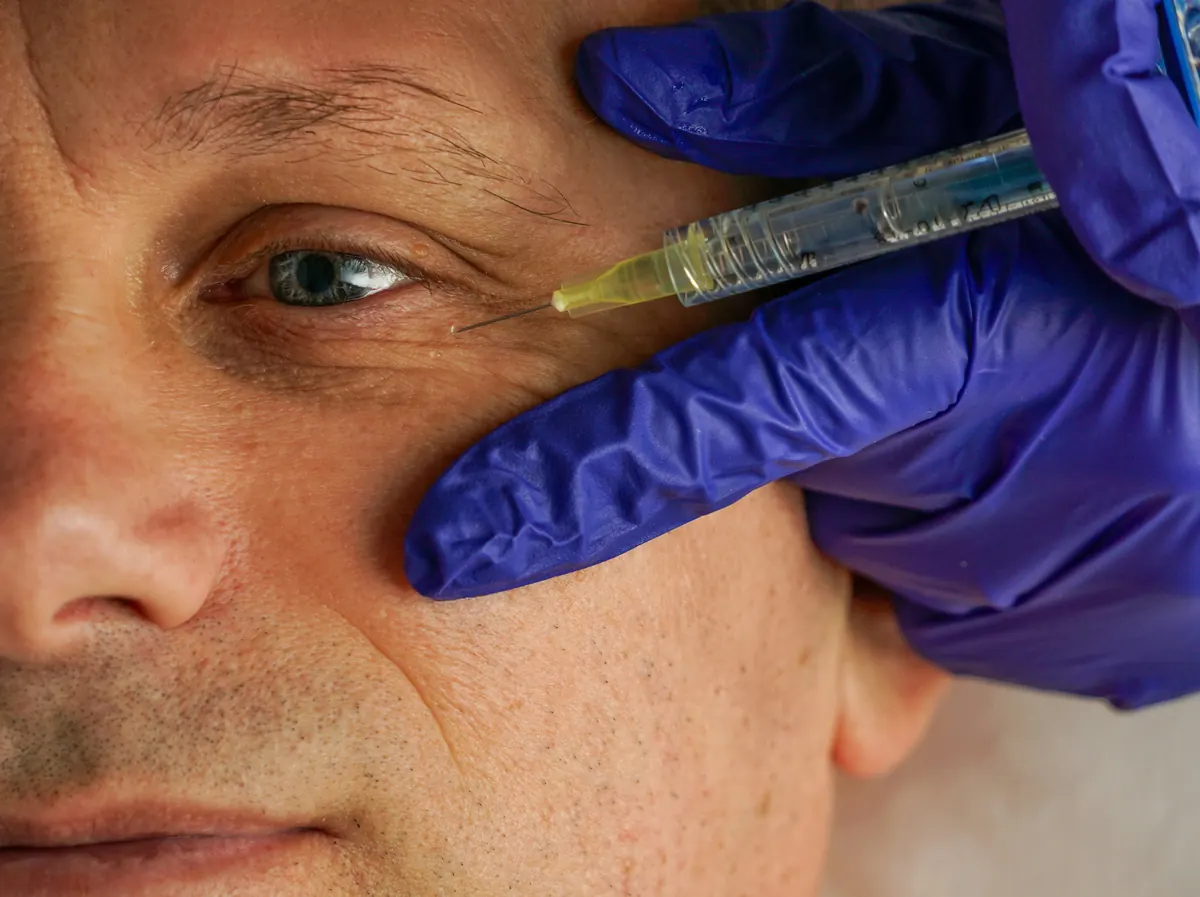
The frown line injection points sit in the corrugator and procerus muscles, between and just above the eyebrows. Directly beneath them, separated by a thin bony rim and some soft tissue, is the orbit. If some of the dose travels downward through the septum rather than staying in the target muscle, it reaches the levator, which then does its job less well. The lid drops by a millimetre or two.
What makes diffusion more likely is a short list, and it is the same list the label uses to give prevention advice:
- Injecting too close to the bony ridge above the eye, or below it.
- Too much volume at a point, so the fluid spreads further than intended.
- Injecting too deep.
- Anatomy: a larger brow depressor complex puts more muscle, and more injecting, near the danger zone.
Note what is not on that list: anything you did afterwards. Which brings us to a piece of advice you have certainly been given.
Being told not to rub the area, lie down, or exercise for a few hours afterwards is standard, and it is reasonable caution. But the mechanism above happens in the tissue within minutes to hours of injection, and the strongest determinants are placement, depth and dose. If you have developed a drooping lid, it is worth knowing that it is far more likely to be about where the needle went than about whether you went to the gym. Our aftercare guide covers what the post-injection rules are actually for.
4. How common it actually is
"Rare" is the usual answer, which tells you nothing. The manufacturer's own trial data gives real numbers:
| Treatment | Eyelid ptosis | Brow ptosis | On placebo |
|---|---|---|---|
| Frown lines (glabellar), 20 units | 3% | Not among most common | 0% |
| Forehead with frown lines, 40 units | 2% | 2% | 0% / 0% |
| Crow's feet (lateral canthal), 24 units | Not among most common | Not among most common | — |
So roughly one person in thirty having frown lines treated in the approval trials developed a drooping lid. That is uncommon, but it is not vanishingly rare, and it is a great deal more common than the "practically never happens" you may have been told. Published series from very experienced injectors report figures well under 1%, while ranges up to the low teens appear in the wider literature. The spread between those numbers is mostly the injector, which is the single most useful thing this section can tell you.
Worth noticing from the same table: crow's feet treatment does not carry eyelid ptosis among its most common reactions, despite being the injection closest to the eye. Distance from the eye is not the driver. Proximity to that one muscle is.
5. When it appears, and when it goes
Botox does not act instantly. The label describes chemical denervation beginning one to two days after injection and increasing in intensity through the first week, which is exactly the window in which a drooping lid shows up. Typically it appears within the first week, sometimes as late as day 7 to 10.
So if your lids look level on day two, you are not yet clear. And if you notice a droop on day five, that timing is entirely consistent with the injection rather than being a coincidence.
Resolution is the reassuring part. Most cases resolve within two to four weeks, which is much sooner than the three to four months the intended result lasts. The reason is dose: only a small fraction of the toxin diffused to the levator, and a small amount at the edge of its effect wears off long before a full therapeutic dose in the target muscle does. Occasionally it runs longer, up to a couple of months, but it does resolve. Permanent ptosis from cosmetic botulinum toxin is not a recognised outcome.
6. The eye drop that works, and what it does
This is the part most articles leave out, and it is the reason to have your diagnosis right.
For true eyelid ptosis, the first-line treatment is a prescription eye drop: apraclonidine 0.5%, sold as Iopidine. It is an alpha-adrenergic agonist. There is a second, smaller muscle in the upper lid called Muller's muscle, which is under adrenergic rather than voluntary control, and it was never affected by the toxin. Apraclonidine makes it contract, which lifts the lid by roughly one to three millimetres. That is often enough to make the asymmetry unnoticeable.
Practical details worth knowing:
- It is typically used as one to two drops, three to four times a day, until the ptosis resolves. Your prescriber sets this, not the internet.
- It is a workaround, not a cure. It props the lid up while the toxin wears off. Stop the drops and the droop returns until the toxin has gone.
- It needs a prescription, which means a doctor, ideally the one who injected you or an ophthalmologist.
- Oxymetazoline 0.1%, sold as Upneeq, is an FDA approved treatment for acquired drooping eyelid and works on the same muscle, dosed once daily. It is the other option to ask about.
None of this applies to brow heaviness. There is no muscle in your forehead that a drop can reach.
7. If it is your brow, what actually helps
If the mirror test in section 2 pointed to a heavy brow, the honest answer is that patience is most of the treatment. Your frontalis was doing more work holding your eyebrows up than you realised, and it has been switched down. It comes back on the treatment's own schedule, so three to four months, improving noticeably in the last few weeks.
What can sometimes help, and it is worth asking your injector rather than attempting to arrange yourself:
- A small corrective injection into the brow depressors. The muscles that pull the brow down can be selectively relaxed, letting whatever frontalis function remains lift a little more. This is a real technique and it needs someone who knows the anatomy well. It is also adding toxin to fix toxin, so it is a judgement call.
- Nothing else, really. No cream, no massage, no device, and no drop. Anything promising to reverse Botox in the forehead is selling you something.
The prevention is the useful lesson: the label explicitly directs that forehead lines be treated in conjunction with frown lines specifically to minimise the potential for brow ptosis. A forehead treated alone, with the depressor muscles left at full strength, is the classic setup for a heavy brow. If you had your forehead done on its own and now feel weighed down, that is the mechanism, and the fix next time is the combination rather than a smaller forehead dose alone.
8. The label's four prevention rules
BOTOX Cosmetic's prescribing information gives four specific steps to reduce the risk of ptosis when treating frown lines. They are worth reading as a patient, because they convert directly into questions that reveal whether your injector is working to the anatomy or to a template:
- Avoid injection near the levator palpebrae superioris, particularly in patients with larger brow depressor complexes.
- Place lateral corrugator injections at least 1 cm above the bony supraorbital ridge (the bony rim you can feel above your eye).
- Keep the injected volume and dose accurate, and where feasible to a minimum.
- Do not inject closer than 1 cm above the central eyebrow.
Two of those four are measurements. "At least 1 cm above the bony ridge" and "not closer than 1 cm above the central eyebrow" are things an injector either knows and observes or does not. Asking, at a consultation, how far above the orbital rim they place their lateral points is a completely reasonable question and a very informative one. So is asking whether they palpate the bony rim first.
The other prevention worth stating: this risk sits mostly with the person holding the syringe. Before a first appointment, confirm they are actually licensed to inject in your state, which you can do yourself in a couple of minutes with our 50 state license verification guide. Our units guide covers what a normal dose per area looks like, which is the other half of rule three.
9. What is not Botox ptosis
Almost everything after cosmetic Botox is minor and self-limiting. A short list is not, and distinguishing them matters:
- Double vision. Diplopia means a muscle moving the eyeball itself has been affected, not just the lid. Report it the same day.
- You cannot fully close the eye, or the eye is becoming dry, red or painful. A lid that will not close leaves the cornea exposed, and that needs an eye doctor, not a wait.
- Difficulty swallowing, slurred speech, generalised weakness or any breathing difficulty. These are the symptoms in the boxed warning on every botulinum toxin label, covering spread of toxin effect beyond the injection site, reported anywhere from hours to weeks after injection. Swallowing and breathing difficulties are described in that warning as potentially life threatening. This is emergency care, not a call to the clinic on Monday.
- A droop that came with a severe headache, a change in pupil size, or new neurological symptoms, especially without a recent injection. Ptosis has serious medical causes unrelated to Botox, and a coincidence of timing is possible.
Also worth ruling out something simpler. Swelling in the first day or two after injection can make a lid look heavier without any toxin having reached the levator, and it settles on its own. And puffiness under the eye is a different subject with different causes, covered in our guide to Botox under the eyes.
10. What to say to the clinic, and next time
Call them. Not to complain, but because this is information they need and because the drops require a prescription. A reasonable clinic will want to know, will see you, and will document the dose and the injection map used, which is what makes your next treatment safer.
What to ask for:
- An assessment of whether this is eyelid ptosis or brow heaviness. Say you would like to know which, in those words.
- If it is eyelid ptosis, a prescription for apraclonidine 0.5% or a referral to someone who can prescribe it.
- Their record of exactly where and how much they injected, so it can be adjusted next time.
- A plan for the next treatment: fewer units at the affected point, placement further from the orbital rim, or treating the forehead together with the frown lines rather than alone.
On whether to go back to the same injector: a single case of ptosis is a recognised complication of a correctly performed treatment, not proof of incompetence. The trial data says one in thirty. How they respond to it is the more informative signal. Someone who sees you promptly, tells you plainly which of the two you have, arranges the drops and changes their plan for next time is doing the job. Someone who tells you it is impossible, that it must be because you rubbed it, or that nothing can be done, is telling you to find someone else.
And the reassurance is worth repeating, because if you found this page in the first week you are probably not in the mood to believe it: it goes away. Two to four weeks for the lid, one treatment cycle for the brow, and no lasting effect either way.
The same mechanism, deliberately. If a heavy brow is what you have, the reverse of it is a real treatment: relaxing the muscles that pull the brow down gives a Botox brow lift of a millimetre or two.
If it was Dysport. Its glabellar trials put eyelid drooping at 2% against under 1% on placebo, mostly mild and resolving over several weeks, and the label names two technique points that reduce it. See Dysport side effects.
If it was Xeomin. Its cosmetic trials report brow ptosis rather than eyelid ptosis, at 0.7% to 1%, which is a heavy brow rather than a falling lid. The eyelid ptosis figure on its label comes from a much larger therapeutic dose. See Xeomin side effects.
Frequently asked questions
How long does a droopy eyelid from Botox last?
Can a droopy eyelid after Botox be fixed?
What is the difference between eyelid ptosis and brow ptosis?
How common is a droopy eyelid after Botox?
When does the droop start after Botox?
Did I cause my droopy eyelid by rubbing my face or exercising?
Which Botox area causes droopy eyelid most often?
Can Botox fix a droopy eyelid?
Should I go back to the same injector after this?
When is a droopy eyelid after Botox an emergency?

Sources
Every figure on this page was read from the documents below rather than from a clinic or a manufacturer's marketing. They open in a new tab so you can check any claim here against its source.
- BOTOX Cosmetic prescribing information, FDA via DailyMed
- OnabotulinumtoxinA injection, MedlinePlus, US National Library of Medicine
- Botulinum toxin treatment overview, American Academy of Dermatology