Botox in the Mid-Face: Cheeks, Nasolabial Folds and the Line That Decides It
Reviewed for medical accuracy against our Medical Review Board · Last updated 5 September 2026
Part of Botox Guides and Basics
Neither the cheeks nor the nasolabial folds are an approved area for any of the six toxins, and in most cases the reason is not caution. It is that the thing being treated is not made of movement.
1. The test that decides this in ten seconds
Look in a mirror with your face completely still. Then smile.
A line that is only there when you smile is made by muscle, and a toxin acts on muscle. A line that is there when your face is still is made by volume loss and skin change, and no amount of relaxing a muscle will address it. That is the whole distinction, and it decides almost every mid-face question.
Nasolabial folds are, for most people, in the second category. So are flat or hollow cheeks. This is why the answer below keeps arriving at filler, and it is not a preference.
2. What "cheek Botox" usually means
The phrase covers three different requests, and they have three different answers.
- "I want fuller or lifted cheeks." That is volume, and a toxin adds none. Cheek filler is the treatment that matches the request.
- "I have lines on my cheeks when I smile." Those are usually the outer extension of crow's feet, and treating the orbicularis oculi at the approved lateral canthal sites often softens them. That is on-label work in a neighbouring area rather than cheek treatment.
- "I want my face to look narrower." That is normally the masseter, at the jaw rather than the cheek. Covered in our masseter guide.
Almost nobody asking about cheek Botox wants toxin injected into their cheek. They want one of those three things, and naming which one gets a better consultation.
3. Nasolabial folds, and why filler usually wins
The nasolabial fold runs from the side of the nose to the corner of the mouth. It deepens with age because the mid-face loses volume and the tissue above it descends. Muscle movement contributes, but it is rarely the main driver, and in an at-rest face it contributes nothing at all.
So the honest ranking for this specific concern:
- Filler, placed in the mid-face to restore the support that was lost, or more conservatively along the fold itself. This addresses the actual mechanism. Our comparison of the two treatments covers how they differ.
- Skin treatments for the texture component.
- A toxin, only where a specific muscle is demonstrably deepening the fold on movement, and only in small amounts by someone who does it often.
If a clinic offers you toxin as the primary treatment for a resting nasolabial fold, ask them to explain which muscle they are treating and what it is doing. There is a good answer to that question in a minority of cases, and no answer at all in most.
4. The specific risk of toxin in the mid-face
This is where the off-label point stops being a technicality.
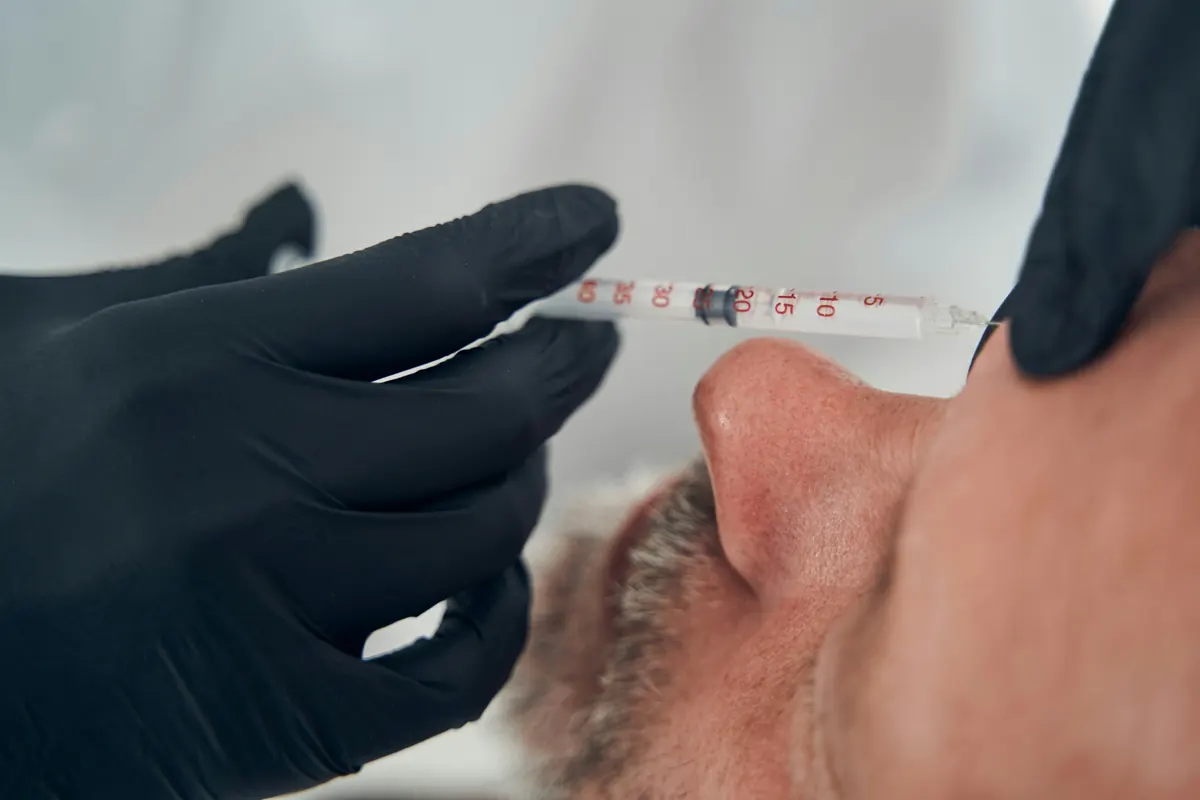
The muscles that lift the corner of your mouth and your upper lip sit exactly here. Weaken them and the visible result is an uneven smile, a lip that does not lift on one side, or difficulty with certain sounds. These are among the more distressing complications on our page about treatments going wrong, precisely because a smile is not something you can hide while it resolves.
Two things make this area less forgiving than the forehead. There is no approved injection map, so depth and placement rest entirely on the injector's experience. And the label's boxed warning concerns the effect spreading beyond the injection site, which matters more when the muscles you did not intend to treat are millimetres away and control your expression.
It resolves, as everything does. It takes the same weeks to months as any other result.
5. Where a toxin genuinely does help down here
Being precise so this does not read as a blanket no. Lower-face toxin work that has a real rationale:
- A gummy smile, where a specific muscle lifts the upper lip too far. A small, targeted, well-described treatment.
- Marionette lines and a downturned mouth corner, by relaxing the muscle pulling the corner down. Covered in our marionette lines guide.
- Masseter treatment for jaw width or clenching.
- Chin dimpling, where the mentalis is genuinely overactive.
What those four have in common is a named muscle doing something visible on movement. That is the pattern to look for. None of them is approved either, and all of them have a mechanism you can be told in one sentence.
6. What to ask
- Which muscle, and what is it doing? A specific name is a good sign. "The cheek area" is not.
- Is this line there when my face is still? If yes, ask why a toxin is being proposed.
- How many of these do you do a month? On an off-label area the operator's experience is the protocol, because there is no other one.
- What does it look like if it is too much? Someone who answers this readily has seen it and knows how to avoid it.
Our area by area guide covers what every part of the face responds to, and units by area covers the doses used where no labelled one exists.
Frequently asked questions
Can you get Botox in your cheeks?
Does Botox work on nasolabial folds?
Is Botox for smile lines safe?
Botox or filler for nasolabial folds?
How do I know if my line needs Botox or filler?
Sources
Every figure on this page was read from the documents below rather than from a clinic or a manufacturer's marketing. They open in a new tab so you can check any claim here against its source.
- BOTOX Cosmetic (onabotulinumtoxinA) for injection, full prescribing information, US National Library of Medicine, DailyMed
- FDA-approved botulinum toxin products, US Food and Drug Administration

Know the count before the quote. The unit count is half the bill, and a low per-unit rate recovered by a high unit count is the commonest way a deal is not one. How to tell.
Deciding which area, not how many units? Botox by facial area covers what each zone actually achieves, which four are FDA approved, and the things Botox cannot fix at all.