
The Botox Brow Lift: How It Works and What It Can Lift
Reviewed for medical accuracy against our Medical Review Board · Last updated 21 August 2026
Part of Botox by Facial Area
A Botox brow lift does not lift anything. It relaxes the muscles that pull your brow down, so the one muscle that pulls it up wins the tug-of-war and the brow settles a millimetre or two higher. It takes 4 to 12 units, it is off-label, and it is the same mechanism that causes a heavy brow when it is done the wrong way round.
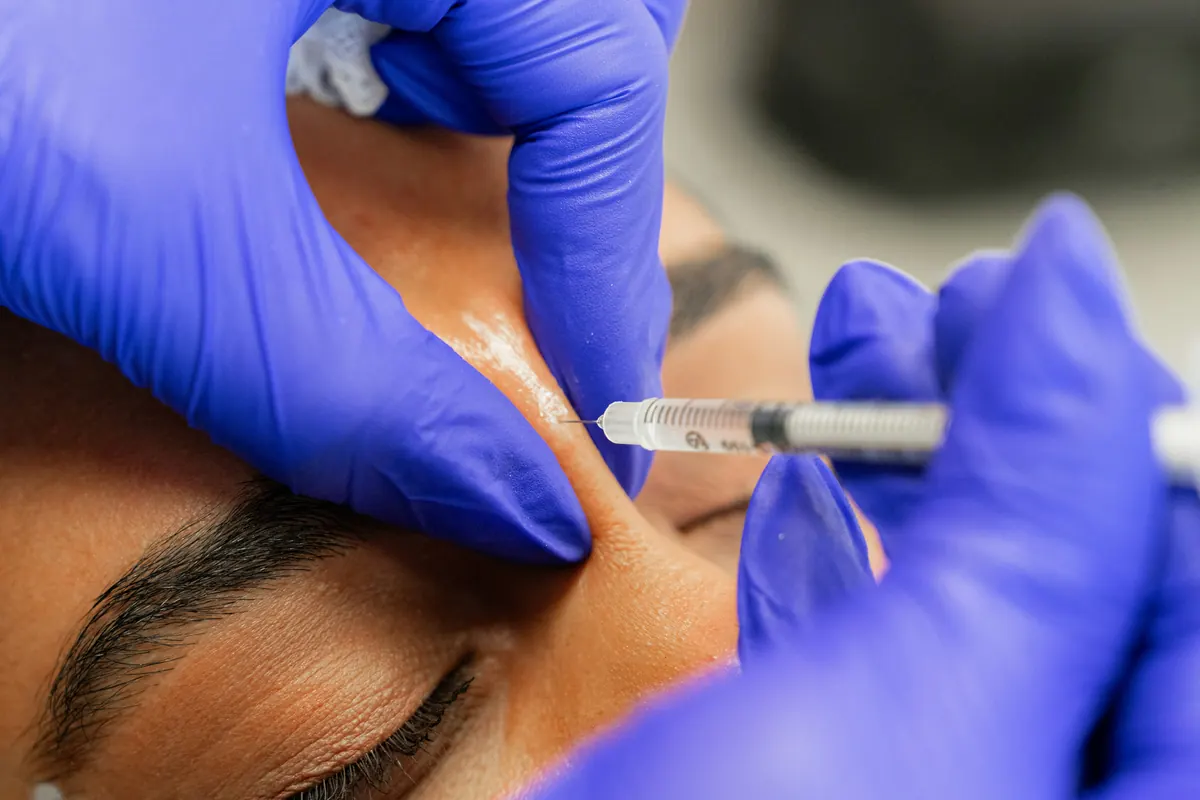
Your eyebrow position is the outcome of a constant argument between one muscle lifting and several pulling down. Every brow result, good and bad, comes from that argument being tipped one way or the other. Once you can see it that way, both the lift and the dreaded heavy brow stop being mysterious.
1. The tug-of-war that sets your brow height
There is exactly one muscle that raises your eyebrows: the frontalis, a broad thin sheet across your forehead. When you look surprised, that is the frontalis, and the horizontal lines across your forehead are the creases it makes.
Pulling in the other direction are several:
| Muscle | Pulls | Where |
|---|---|---|
| Frontalis | Up | Across the forehead, the only lifter |
| Orbicularis oculi (outer part) | Down | The ring around the eye, pulling the outer brow down |
| Corrugator supercilii | Down and inward | Between the brows, the frowning muscle |
| Procerus | Down | Over the bridge of the nose |
| Depressor supercilii | Down | At the inner end of the brow |
One up against four down. Where your brow sits at rest is simply where that contest currently balances, and it is why brows drop with age even before skin laxity is the main issue: the downward group keeps working while the lifter tires.
2. How the lift is actually produced
So there are two ways to change brow height with a neurotoxin, and only one of them lifts.
Relax the depressors. Put small amounts into the outer part of the orbicularis oculi, and often the corrugator and procerus between the brows. The downward pull weakens, the frontalis is unopposed, and the brow rises slightly. That is the brow lift.
Relax the frontalis. This is what treating forehead lines does. Smooth the horizontal lines and you have switched off the only muscle holding the brow up. If the depressors are left at full strength, the brow falls. That is a heavy brow, and it is the most common Botox complaint there is.
Same drug, same face, opposite results, decided entirely by which side of the argument you weaken. This is why our companion article on a drooping lid after Botox spends so much time separating a heavy brow from true eyelid ptosis: they look similar in a mirror and only one of them has a treatment that works today.
3. The label's own proof that this is real
You do not have to take a clinic's word for the tug-of-war, because the manufacturer's prescribing information effectively states it.
BOTOX Cosmetic's label instructs that forehead lines be treated in conjunction with glabellar lines, and gives the reason plainly: to minimise the potential for brow ptosis. The approved regimen is 20 units into the frontalis together with 20 units into the glabellar complex, 40 units in total, and it is not presented as an option.
Read what that means. The manufacturer will not have you weaken the lifter without also weakening some of the depressors, because doing so drops the brow. A regulator-reviewed document telling injectors to treat two muscle groups together to protect brow position is much better evidence than the usual assertion on a clinic page.
It also gives you a practical test of an injector. If you ask for your forehead alone, treated lightly, and they explain why they would rather treat the glabella at the same time, they are working from the label. Our frown lines guide covers that area's own protocol.
4. How much lift, honestly
Here is where this article parts company with most of the internet.
A chemical brow lift produces, in most people, one to two millimetres of elevation at the outer brow, occasionally a little more in someone with strong depressors and a strong frontalis. It is measurable. It is not dramatic.
To put that in context, a millimetre or two is about the thickness of a stack of two or three sheets of paper. It can genuinely change how open your eye looks, particularly if the outer brow was sitting low and crowding the lid. It cannot reproduce a surgical brow lift, and the before-and-after photographs suggesting otherwise are usually doing at least one of these:
- Raising the chin or lowering the camera in the after shot, which lifts every brow ever photographed.
- Using a relaxed, slightly closed eye in the before and an alert, wide eye in the after.
- Better light, or eyebrows groomed and pencilled higher.
- Showing a combined result where filler or a device treatment also happened.
Ask to see photographs taken at the same angle, same light, same expression. A clinic that has them is confident in a genuine result.
5. Units, points and the lateral tail
Doses are small because the target muscles are small and superficial:
- Lateral brow only, treating the outer orbicularis oculi: roughly 2 to 4 units per side, so 4 to 8 in total. This is the classic tail-of-the-brow lift and the most predictable version.
- With the glabellar depressors, adding the corrugator and procerus: brings the total to around 10 to 20 units depending on how much of the glabellar complex is treated, and lifts the inner brow as well as the outer.
- Placement is usually just above and lateral to the outer end of the brow, and it stays superficial. Depth here is what separates a lift from a complication.
The label's own precautions for the glabellar area apply directly: keep lateral injections at least 1 cm above the bony ridge above the eye, do not inject closer than 1 cm above the central eyebrow, and keep the dose accurate and to a minimum. Those are measurements an injector either observes or does not, and they are reasonable to ask about. Our units guide lists the ranges for every area.
6. Who it works for, and who needs surgery
It works best if:
- Your outer brow sits low and the tail droops, crowding the outer eye.
- Your brows are noticeably uneven, since one side can be treated more than the other. Asymmetry is one of the better uses of this treatment.
- Your frontalis is still strong. It has to do the lifting, so this works less well in someone whose forehead muscle is already weak or heavily treated.
- You want to test the idea of a higher brow before considering anything surgical.
It will not help if the problem is skin. This is the important limit. If you have excess upper eyelid skin resting on your lashes, or heavy hooding that stays put when you raise your brows with your fingers, that is skin laxity, and there is no dose of any neurotoxin that removes skin. The surgical answers are a blepharoplasty for the lid skin or a brow lift for the brow itself, and no amount of injecting substitutes.
A simple self-test: look in a mirror and lift your brows gently with your fingertips to roughly where you would like them. If your eyes look markedly more open and the hooding largely resolves, a chemical lift may give you a fraction of that. If lifting your brows barely changes the hooding, the problem is the lid skin and injecting will not touch it.
7. When it goes the wrong way
Three ways this treatment disappoints, and all three are predictable from the tug-of-war:
The brow drops instead of lifting. Almost always because the frontalis was treated too heavily or too low, so the lifter lost the argument. This is brow ptosis, it appeared in 2% of people in the forehead-line trials, and it lasts as long as the treatment does, three to four months. There is no eye drop for it. Full detail in our droopy eyelid after Botox guide.
The brow lifts unevenly. One side rises more, usually because the depressors were not equally strong to begin with or the dose split was not quite right. Easily corrected with a unit or two on the lower side once the result has settled at two weeks, so do not let it be corrected on day three.
The Spock brow. A hard peak at the outer brow, arching sharply upward. This happens when the central frontalis is relaxed but its outer fibres are not, so the only part of the lifter still working pulls the brow tail up in isolation. It looks quizzical and it is the most common cosmetic complaint after upper-face treatment. It is fixed with a small dose into those outer fibres, and it is worth knowing the name so you can describe it.
8. Against a surgical lift and a thread lift
| Botox brow lift | Thread lift | Surgical brow lift | |
|---|---|---|---|
| What it changes | Muscle balance | Tissue position, with sutures | Tissue and skin, permanently |
| Typical lift | 1 to 2 mm | Modest, variable | Substantial, planned |
| Removes skin | No | No | Yes |
| Lasts | 3 to 4 months | Months to about a year | Years |
| Downtime | None | Some bruising and swelling | Real surgical recovery |
| Reversible | By waiting | Not readily | No |
The honest way to use the cheapest option first: a chemical lift tells you whether you actually like your brow higher, for a few hundred dollars and no downtime, before you consider anything permanent. Our comparisons of Botox against a thread lift and against a facelift go into each in more detail.
9. What it costs at real published rates
At 4 to 12 units this is a small treatment, priced against the per-unit rates clinics publish in the cities we verify:
| Published rate | Per unit | 4 to 12 units |
|---|---|---|
| Lowest we found | $9 | $36 to $108 |
| Middle of the range | $12 | $48 to $144 |
| Highest we found | $18 | $72 to $216 |
These are rates clinics actually publish, read off their own price pages rather than estimated: the floor is $9 a unit in Atlanta, GA and the ceiling $18 in Tampa, FL. Your own city may sit outside that range entirely. We check published pricing city by city, and the locations index lists every city covered so far, with the named clinics and their rates.
As with any small treatment, minimum spend is the thing that changes the real number, so ask whether one applies. And ask whether the quoted price is for the lateral brow alone or includes the glabellar complex, because that is the difference between roughly 4 units and roughly 20. Many clinics fold a brow lift into an upper-face package with the forehead and frown lines, which given section 3 is usually the sensible way to buy it.
10. What to ask before you agree
- Is my problem muscle or skin? Ask them to do the fingertip test with you and say which they think it is.
- How many millimetres of lift do you expect for me? A specific, modest answer is a good sign.
- Are you treating the lateral brow only, or the glabellar depressors as well? How many units for each?
- If you are also treating my forehead, how are you protecting my brow position?
- How far above the orbital rim do you place the lateral points? The label says at least 1 cm.
- Can I see before and after photographs taken at the same angle and expression?
- If one side lifts more, when do we assess and correct it? The answer should be about two weeks.
Judge the result at two weeks, not at day three. And if what you actually want is your eyelid hooding gone rather than your brow a little higher, the useful conversation is with a surgeon, and a good injector will tell you so.
Every area Botox treats, and what each one takes
Botox is not one treatment, it is eight or so, and the dose ranges by a factor of thirty between the smallest and the largest. 4 of these areas are on the FDA label; the rest are off-label, which is legal and common but means the dose comes from clinical practice rather than from a registration trial.
| Area | Typical dose | FDA status |
|---|---|---|
| Frown lines (glabella) | 20 units | FDA approved |
| Forehead lines | 20 units, with the glabella | FDA approved |
| Crow's feet | 24 units | FDA approved |
| Neck and platysmal bands | 26 to 36 units | FDA approved |
| Brow lift (you are here) | 4 to 12 units | Off-label |
| Lip flip | 2 to 6 units | Off-label |
| Masseter (jaw slimming) | 40 to 60 units | Off-label |
| Under the eyes | 1 to 4 units per side | Off-label |
| Bunny lines (nose) | 2 to 5 units per side | Off-label |
| Gummy smile | 2 to 3 units per side | Off-label |
| Marionette lines | 2 to 8 units per side | Off-label |
Units are not comparable between brands, so these are Botox units. Full ranges per area are in the units guide and calculator.
Frequently asked questions
What is a Botox brow lift?
How much does a Botox brow lift actually lift?
How many units are needed for a brow lift?
Can Botox make my brows droop instead?
What is a Spock brow and how is it fixed?
Is a Botox brow lift FDA approved?
Will a Botox brow lift fix hooded eyes?
How long does a Botox brow lift last?
Is a brow lift with Botox better than a thread lift?
When should I judge the result?

Sources
Every figure on this page was read from the documents below rather than from a clinic or a manufacturer's marketing. They open in a new tab so you can check any claim here against its source.
- BOTOX Cosmetic prescribing information, FDA via DailyMed
- Botulinum toxin treatment overview, American Academy of Dermatology
Keep reading
 Botox Treatment AreasBotox for Crow's Feet
 Botox Treatment AreasBotox for Forehead Lines
 Botox Treatment AreasBotox for Frown Lines and the Glabella (the "11s")
 Botox Treatment AreasMasseter Botox for Jaw Slimming and Bruxism
 Botox Treatment AreasThe Nefertiti Lift and Neck Botox
 Areas and SafetyBotox Around the Eyes