
Botox for Frown Lines and the Glabella (the "11s")
Reviewed for medical accuracy against our Medical Review Board · Last updated 18 August 2026
Part of Botox by Facial Area
Frown lines between the eyebrows take roughly 15 to 30 units of Botox, the highest dose of any upper-face area. That is because the glabella is not one muscle but five, pulling in three directions, and this was the original area Botox Cosmetic was approved to treat.
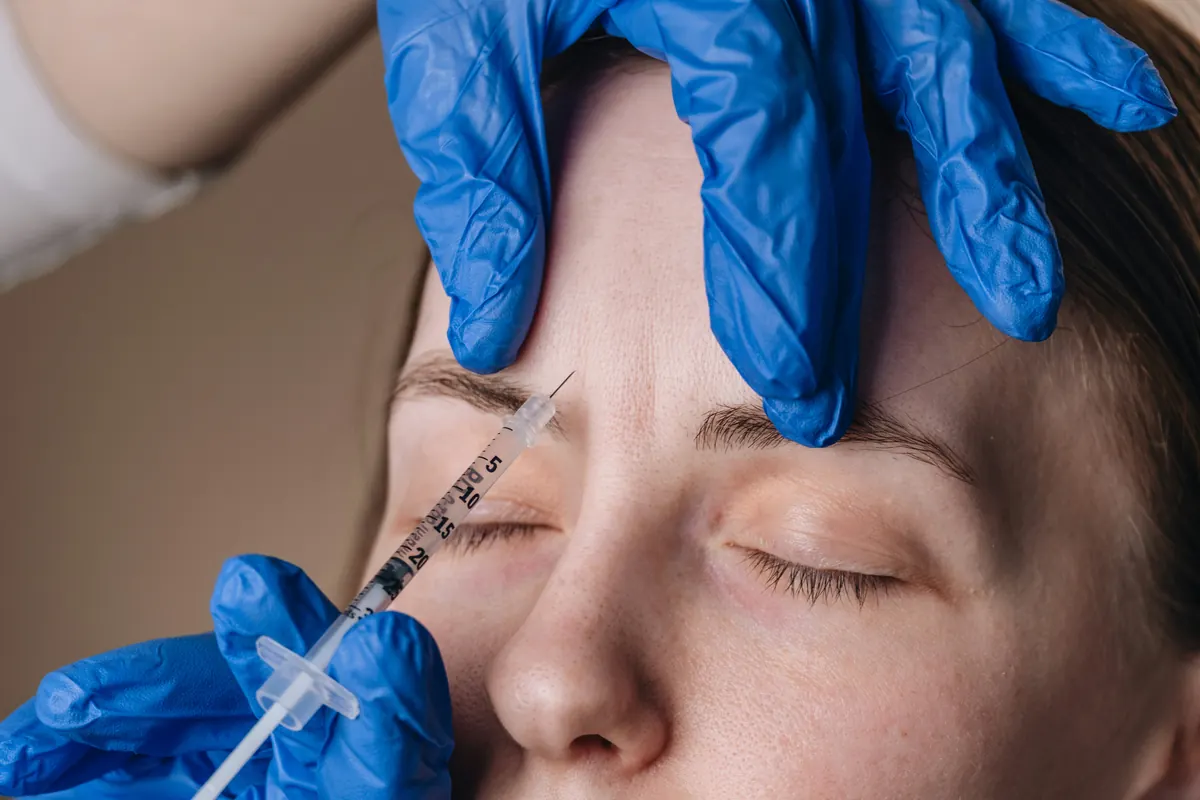
The vertical lines between your brows are known as the "11s", and clinically as glabellar lines. They are the most-treated area in aesthetics, and the best understood. If you want to know what good practice looks like anywhere on the face, this is the area where the evidence is deepest.
1. What the "11s" are, and the muscles behind them
Frown at yourself in a mirror. The two vertical lines that appear between your brows are the 11s. The nickname comes from their shape; some people make one line, some three, some a horizontal crease across the bridge of the nose instead.
What makes this area demanding is that several muscles act on it at once. The group is usually described as:
- The corrugator supercilii, one each side, which pulls the brows together and slightly down. These are the main producers of the vertical 11s.
- The procerus, sitting over the bridge of the nose, which pulls the inner brow down and creates the horizontal line across the nose bridge.
- The depressor supercilii, small depressors at the inner brow.
- The medial fibres of the orbicularis oculi, which also contribute a downward pull at the inner corner.
Five or so muscles, three directions of pull, in an area a few centimetres across. That is the whole explanation for why the dose here is higher than anywhere else in the upper face, and why placement matters more.
2. Why this is the reference area for all Botox dosing
Botox Cosmetic was approved by the FDA for moderate to severe glabellar lines on 12 April 2002. Crow's feet followed in 2013, and forehead lines in 2017. For over a decade the glabella was the only cosmetic indication there was.
That history has a practical consequence: the clinical trial data, the dosing conventions and the safety guidance for this area are deeper than for any other. When you read that a brand is "equivalent" to Botox at some ratio, or that a new toxin lasts longer, the study behind that claim was almost certainly run on glabellar lines. It is the reference area for the entire category.
Why that helps you. If an injector's approach to the glabella is sound, in dose, in placement and in what they tell you about risk, that is a reasonable signal about the rest of their practice. This is the area where there is least excuse for improvisation.
3. Not everyone frowns the same way
This is where competent treatment separates from formulaic treatment. The pattern of muscle pull when you frown is not the same in everyone, and the injection pattern should follow yours. Clinicians commonly describe several recognisable patterns, including:
- Converging, where the brows pull straight towards each other, giving the classic two vertical lines.
- An inverted-V or omega shape, where the inner brow lifts as the rest pulls in.
- A U or V pattern, depending on how much the depressors dominate.
- A pattern with a strong horizontal nose-bridge line, where the procerus is doing most of the work.
An injector who watches you frown, hard, several times, before deciding where the needle goes is assessing this. One who marks the same five points on everyone is not. The dose can be identical and the results markedly different, purely from placement.
So expect to be asked to frown, and expect it to feel slightly ridiculous. It is the assessment.
4. Why the dose is the highest in the upper face
The working range is 15 to 30 units. Compare that with 10 to 20 for the whole forehead, 5 to 15 for crow's feet, and 2 to 4 per side under the eyes. The glabella takes the most because there is the most muscle to address, and because these muscles are strong.
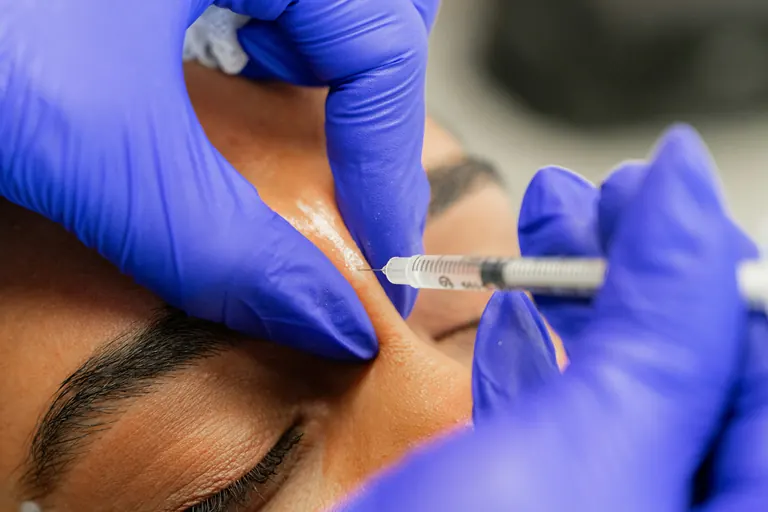
The FDA-approved regimen for glabellar lines is 20 units divided across five injection points. In practice:
- Men frequently need the upper end or beyond. Corrugator bulk is often substantially greater.
- Strong frowners need more, and if you can feel the muscle bunch firmly under your fingers when you frown, you are probably one.
- Under-dosing shows up as partial movement, which is a common cause of the complaint that Botox "did not work". Frequently it worked, at a dose too low for your muscle.
Unlike the forehead, erring low here has less downside on appearance, because relaxing brow depressors tends to let the brow sit slightly higher rather than lower. The trade-off is different in the two areas, which is the subject of section 7. Full dosing for every area is in our units guide and calculator.
5. What it costs at real published rates
Because this area takes the most units, it is usually the most expensive single upper-face area. Below is 15 to 30 units against the per-unit prices actually published by clinics in the cities we verify.
| Published rate | Per unit | 15 to 30 units |
|---|---|---|
| Lowest we found | $9 | $135 to $270 |
| Middle of the range | $12 | $180 to $360 |
| Highest we found | $18 | $270 to $540 |
These are rates clinics actually publish, read off their own price pages rather than estimated: the floor is $9 a unit in Atlanta, GA and the ceiling $18 in Tampa, FL. Your own city may sit outside that range entirely. We check published pricing city by city, and the locations index lists every city covered so far, with the named clinics and their rates.
Many clinics quote the glabella and forehead together as an upper-face package, which is often better value than the two priced separately, and is also the combination the approved forehead regimen uses. Ask for both prices. Our Botox price guide covers state averages and the per-unit versus per-area question.
6. Eyelid ptosis, and the one-centimetre rule
The complication specifically associated with this area is eyelid ptosis: the upper lid droops because toxin has reached the levator palpebrae superioris, the muscle that opens the eye. It is uncommon, it is temporary, and there is no reversal agent, so it resolves on its own timescale of weeks to a few months.
What is worth knowing is that this is a technique matter, and the manufacturer's own instructions are specific about it. They direct injectors to avoid injecting near the levator, to take particular care in patients with a larger brow depressor complex, and to place the lateral injections at least 1 cm above the bony ridge of the brow.
You are not going to measure your injector's needle placement. But you can ask the question in section 10, and a clinician who can explain why they stay well above the orbital rim is telling you they know where the risk is. That is a more useful signal than any before-and-after photograph.
Distinguish this from brow heaviness, which is a different problem with a different cause and is associated with forehead treatment rather than this area. We separate the two in Botox for forehead lines.
7. Why the glabella can be treated alone but the forehead cannot
This asymmetry catches people out, so it is worth stating plainly.
The frontalis, your forehead muscle, is the only muscle that raises your eyebrows. Every muscle in the glabellar complex pulls the brow down. So:
- Glabella alone relaxes brow depressors. The lifter is untouched, so the brow tends to sit the same or slightly higher. This is a common, sensible standalone treatment, and it is often the right first treatment for someone in their late twenties or thirties.
- Forehead alone relaxes the only lifter while leaving the depressors at full strength. The brow can settle lower and feel heavy. This is why the approved forehead regimen pairs 20 units in the frontalis with 20 units in the glabellar complex.
If you are only going to treat one upper-face area, this is usually the one.
8. When the 11s are too deep for Botox alone
Relax your face completely and look at the lines. If they are still clearly visible when nothing is moving, they are static: the crease is now in the skin, not only in the movement.
Botox stops the folding, and over several months a static line often softens because the skin is no longer being creased hundreds of times a day. Repeated treatment tends to improve them further. But deep etched 11s usually will not disappear on Botox alone, and being told otherwise is the most common source of disappointment in this area.
For a deep residual crease, a small, carefully placed amount of filler is sometimes used in addition to the toxin. This region is a high-risk area for filler because of the blood vessels running through it, so it is not a casual add-on and should only be discussed with an experienced injector. Skin resurfacing is the other route. See Botox versus fillers for how the two differ.
9. How long it lasts
Roughly three to four months, with onset in a few days and full effect at about two weeks. Glabellar results often last as long as or slightly longer than the forehead, because the dose is higher relative to the muscle and because you are probably not frowning as continuously as you are raising your brows.
Longevity tends to improve over repeated treatments. A muscle that has been relaxed for long periods does less work, and some people find they need treatment less often after a few cycles. That is a genuine pattern rather than a sales line, though it varies and is not guaranteed.
10. What to ask before you agree
- Will you watch me frown before you decide where to inject? The answer should be yes, and it should happen.
- How many units, across how many points, and why that number for me?
- How do you place the outer injections to keep away from the eyelid muscle? You are listening for an explanation involving distance from the bony brow ridge.
- Are my 11s dynamic, static, or both, and what would you use for the static part?
- Should I treat my forehead at the same time, and what happens to my brows if I do or do not?
- Is a two-week review included, and is a top-up charged separately?
And the check that costs nothing: confirm your injector holds a current license. The records are public and free. We list the lookup for every state in how to verify a Botox injector's license.
If your eyelid drops afterwards. This is the area where eyelid ptosis is most likely, at 3% in the approval trials. There is a specific treatment for it, and it is not the same as a heavy brow: see droopy eyelid after Botox.
These muscles pull the brow down. Treating them is also how a Botox brow lift is produced, which is why this area is often treated with brow position rather than lines in mind.
Every area Botox treats, and what each one takes
Botox is not one treatment, it is eight or so, and the dose ranges by a factor of thirty between the smallest and the largest. 4 of these areas are on the FDA label; the rest are off-label, which is legal and common but means the dose comes from clinical practice rather than from a registration trial.
| Area | Typical dose | FDA status |
|---|---|---|
| Frown lines (glabella) (you are here) | 20 units | FDA approved |
| Forehead lines | 20 units, with the glabella | FDA approved |
| Crow's feet | 24 units | FDA approved |
| Neck and platysmal bands | 26 to 36 units | FDA approved |
| Brow lift | 4 to 12 units | Off-label |
| Lip flip | 2 to 6 units | Off-label |
| Masseter (jaw slimming) | 40 to 60 units | Off-label |
| Under the eyes | 1 to 4 units per side | Off-label |
| Bunny lines (nose) | 2 to 5 units per side | Off-label |
| Gummy smile | 2 to 3 units per side | Off-label |
| Marionette lines | 2 to 8 units per side | Off-label |
Units are not comparable between brands, so these are Botox units. Full ranges per area are in the units guide and calculator.
Frequently asked questions
How many units of Botox for frown lines?
What are the 11 lines between the eyebrows?
Can Botox get rid of deep 11 lines?
Is Botox for frown lines FDA approved?
Can Botox in the frown lines cause a droopy eyelid?
Can I have Botox in my frown lines only?
How much does Botox for frown lines cost?
Why did my frown line Botox not work?

Sources
Every figure on this page was read from the documents below rather than from a clinic or a manufacturer's marketing. They open in a new tab so you can check any claim here against its source.
- BOTOX Cosmetic prescribing information, FDA via DailyMed
- Botulinum toxin treatment overview, American Academy of Dermatology
- Botulinum toxin, American Society of Plastic Surgeons
Keep reading
 Botox Treatment AreasBotox for Forehead Lines
 Botox Treatment AreasBunny Lines and Botox
 Botox Treatment AreasMarionette Lines and Botox
 Botox Treatment AreasThe Botox Brow Lift
 Botox Treatment AreasBotox for Crow's Feet
 Other NeurotoxinsJeuveau by Area and Units
 Other NeurotoxinsJeuveau Before and After