
Botox Under the Eyes: What It Treats, What It Cannot, and Why Injectors Hesitate
Reviewed for medical accuracy against our Medical Review Board · Last updated 17 August 2026
Part of Botox by Facial Area
Botox under the eyes is off-label, uses a fraction of the dose you would get anywhere else on the face, and does nothing at all for the thing most people are actually asking about.
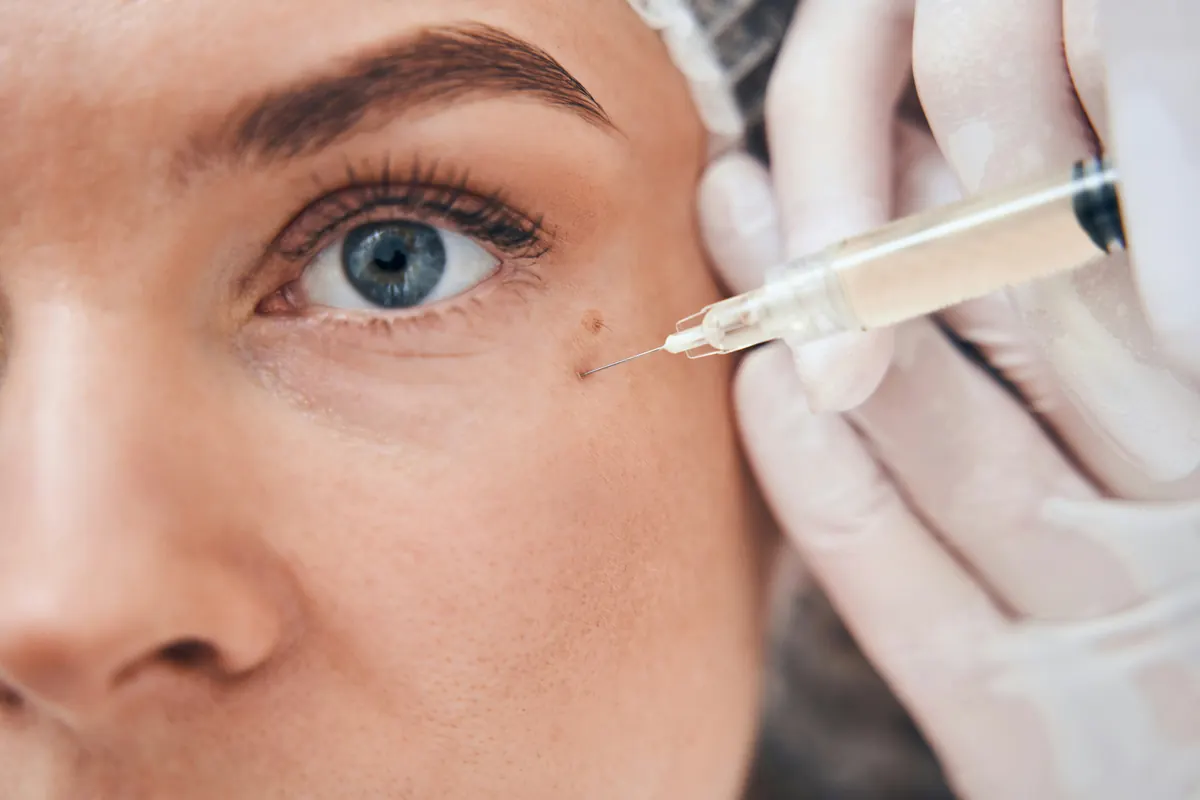
"Under-eye" is the least precise request in aesthetics. Four different concerns get described with the same three words, and Botox has a completely different answer for each one. It treats a specific movement line, it is useless against bags, and used carelessly it can make the area look worse in a way that takes months to resolve.
This guide separates the four concerns, explains why experienced injectors treat this area cautiously or decline it, and sets out what actually works for each problem.
1. The four things people mean by "under-eye"
Before anything else, work out which of these you are looking at in the mirror. The answer decides whether Botox is relevant at all, and getting this wrong is how people end up paying for a treatment that could never have worked.
| What you see | What it actually is | Does Botox help? | What does work |
|---|---|---|---|
| Puffy bags, worse in the morning | Fat herniating through weakened orbital septum, or fluid retention | No. Nothing about a relaxed muscle moves herniated fat | Lower blepharoplasty, or fluid and sleep management if it fluctuates |
| A hollow or shadow in a curve below the eye | Tear trough volume loss, often deepening with age | No. There is no muscle to relax; the problem is missing volume | Hyaluronic acid filler placed by an experienced injector |
| Fine crepey texture, present at rest | Thin skin and collagen loss, a static change | Barely. Static lines are not caused by movement | Retinoids, energy devices, microneedling, skin quality treatments |
| A roll or crease that appears when you smile or squint | The pretarsal orbicularis oculi contracting | Yes, this is the one Botox addresses | 2 to 4 units per side, off-label, by an experienced injector |
There is a fifth area worth separating out, because it is adjacent and often confused: crow's feet, the lines fanning outward from the outer corner. Those are lateral canthal lines, they are FDA approved for Botox, and they take roughly ten times the dose. If someone tells you they are treating your "under-eyes" and injects the outer corners, they have treated your crow's feet, which is a different and much better-established treatment.
2. The one thing Botox actually treats here
The orbicularis oculi is a ring of muscle surrounding the eye. The part sitting directly beneath the lower lash line, the pretarsal portion, contracts when you smile or squint, and in some people that contraction bunches into a visible roll or crease.
That roll is the legitimate target. Relax that specific band of muscle by a small amount and the crease softens when you smile. Some patients also report the eye aperture looking slightly wider, which is why this treatment is sometimes marketed for "opening" the eyes.
Here is the test that settles whether you are a candidate: look in a mirror at rest, then smile. If the line you dislike only appears when you smile, it is dynamic and Botox is plausibly relevant. If it is there when your face is completely still, it is static, and relaxing the muscle will not remove it.
3. Why this is off-label, and what that means
Botox holds FDA approval for glabellar lines, lateral canthal lines and forehead lines on the cosmetic side. Treatment directly beneath the lower lid is not among them. It is an off-label use in the United States.
Off-label is not the same as illegal or improper. Physicians may legally use an approved product outside its approved indications where clinical judgement supports it, and a great deal of good medicine happens this way. But it does change what you should expect:
- The evidence base is thinner. There is no large approval trial establishing a standard dose and safety profile for this specific area.
- Technique matters more. With approved indications there is a documented injection pattern. Here you are relying substantially on your injector's individual experience.
- Your injector should tell you. A practitioner who describes under-eye Botox as routine or approved is either uninformed or not being straight with you.
4. The dose: 2 to 4 units, not 24
The single most useful number in this guide. Experienced injectors typically use 2 to 4 units per side beneath the lower lid. Compare that with the doses used elsewhere on the face:
| Area | Typical total units | Approval status |
|---|---|---|
| Under-eye (pretarsal orbicularis) | 2 to 4 per side | Off-label |
| Crow's feet (lateral canthal lines) | 10 to 24 | FDA approved |
| Glabella (frown "11s") | 15 to 25 | FDA approved |
| Forehead lines | 10 to 30 | FDA approved |
| Masseter (jaw slimming) | 40 to 60 | Off-label |
The reason for such a small dose is not caution for its own sake. The orbicularis oculi holds the lower lid against the eye. Relax too much of it and you have not just softened a line, you have weakened the structure supporting the lid. Our units and dosing guide covers the full picture across every area.
If an injector proposes 10 units per side beneath your lower lid, that is a reason to stop and ask what they are treating and why.
5. Why injectors hesitate: ectropion and lid laxity
Plenty of good injectors decline this treatment, and it is worth understanding why rather than reading a refusal as a lack of skill.
Ectropion. Weakening the lower portion of the orbicularis oculi can reduce the muscle's ability to hold the lid against the eye. The lid can sag or turn outward. That is ectropion, and it is the complication that makes this area different from the rest of the face.
Worse bagginess, not better. Muscle tone contributes to the appearance of the lower lid. Relax it and the area can look more swollen rather than smoother, which is the opposite of what most people came in for.
Fluid stasis. The orbicularis helps move fluid away from the area with each blink. Reduce that pumping action and fluid can linger, causing puffiness that was not there before.
Dry eye and tear distribution. Blinking spreads tears across the eye surface. Affecting the blink can leave the eye less comfortable, and anyone already prone to dry eye is more exposed.
Smile changes. The orbicularis contributes to how your smile reads. Over-relaxing it can flatten expression around the eye in a way people find unsettling even when they cannot name it.
All of these resolve as the product wears off over roughly three to four months. That is a long time to live with a drooping lid. Our aftercare guide covers what to do if something looks wrong in the first weeks.
6. The snap-back test, and why you should expect it
Before treating this area, a careful injector assesses how much laxity your lower lid already has. The standard method is the snap-back test: the lid is gently drawn away from the eye and released. In a lid with good tone it returns to the eye immediately, without you needing to blink.
A lid that returns slowly, or needs a blink to reseat, already has laxity. Adding a muscle relaxant to a lid in that state is how sagging happens. Anyone with meaningful laxity should be declined for this treatment, not dosed more conservatively.
Use this as your test of the clinic. If someone agrees to inject beneath your lower lid without ever touching your lid or examining its tone, they have skipped the assessment that decides whether you are a candidate. That tells you more about the practice than any price does.
7. What actually works for each concern
Most people arriving at this article want their under-eye area to look better and have assumed Botox is the route. Usually something else is.
For bags and puffiness
If the cause is fat herniation, the definitive answer is surgical: lower blepharoplasty. If it fluctuates with sleep, salt and alcohol, then it is fluid, and the answer is behavioural rather than procedural. Neither responds to a neurotoxin.
For hollowing and dark shadows
Tear trough filler, placed carefully. This area is unforgiving of overfilling and poor product choice, so injector experience matters more here than almost anywhere. Our Botox versus fillers guide covers why these products do genuinely different jobs.
For fine crepey texture
Skin-quality treatments. Prescription retinoids have the strongest evidence base; microneedling and energy-based devices address texture and collagen. Compare these in our skin and energy treatments hub.
For lines that appear when you smile
This is the one where Botox belongs, whether beneath the lid in small doses or, more commonly and more safely, at the crow's feet. Many people who ask about under-eye Botox are better served by treating the lateral canthal lines instead, which is FDA approved and considerably lower risk.
8. What it costs
Because the dose is so small, this is one of the cheapest Botox treatments by area, assuming a clinic will do it at all. At 2 to 4 units per side, you are paying for 4 to 8 units total.
| Per-unit rate | 4 units (2 per side) | 8 units (4 per side) |
|---|---|---|
| $9 (lowest we found, Atlanta) | $36 | $72 |
| $12 (common mid-market rate) | $48 | $96 |
| $16 (highest we found, Las Vegas) | $64 | $128 |
Two practical catches. Many clinics apply a minimum charge, often around $125, which means a 4-unit treatment costs the same as a much larger one. And several providers we checked publish rates that only apply above a unit threshold, 20 units at one Atlanta clinic and 50 at two Las Vegas practices, so the headline rate will not apply to a treatment this small.
In practice this is rarely booked alone. It is usually added to a crow's feet or glabella treatment, where the units combine into one visit. Our price guide covers per-unit pricing in detail, and our city guides list published rates clinic by clinic.
9. Who should not have this done
- Anyone with existing lower lid laxity, identified by the snap-back test. This is the main exclusion and it is not negotiable.
- Anyone whose actual concern is bags, hollowing or static texture. The treatment cannot address these, so it can only disappoint.
- Anyone with dry eye or a history of eye surface problems, where reduced blink efficiency carries a real cost.
- Anyone with previous lower lid surgery, where the anatomy and support structures have already been altered.
- First-time Botox patients. A reasonable sequence is to establish how you respond in a lower-risk area first. Anyone treating your under-eyes at your very first appointment is moving faster than the situation warrants.
- Anyone who is pregnant or breastfeeding, in line with general guidance on neurotoxins.
10. What to ask before you agree
- "Is this on-label or off-label?" The correct answer is off-label. An injector who says otherwise has told you something important.
- "How many units per side, and why that number?" Expect 2 to 4. A larger number needs a specific justification.
- "Will you assess my lower lid laxity first?" The answer should be yes, with a snap-back test.
- "Am I actually a candidate, or would crow's feet treatment serve me better?" A good injector will often steer you here themselves.
- "What happens if my lid droops?" There is no reversal agent for a neurotoxin. The honest answer is that it wears off in three to four months, and you want to hear that stated plainly.
- "How many of these have you done?" This is a technique-dependent, off-label treatment. Specific experience matters more than general injecting experience.
If you are new to this, our pre-Botox guide covers what to do before any appointment, and the complete Botox guide covers the mechanism in full.
Other areas around the eyes and brow. Frown lines and the glabella takes the highest dose in the upper face, and forehead lines is the area whose dosing decides where your brows sit.
The approved alternative next door. Crow's feet is FDA approved, takes 12 units a side against 2 to 4 here, and is what many injectors will recommend instead.
A drooping lid is a different thing. Under-eye puffiness and a lid that sits too low have different causes and different answers: see droopy eyelid after Botox.
Every area Botox treats, and what each one takes
Botox is not one treatment, it is eight or so, and the dose ranges by a factor of thirty between the smallest and the largest. 4 of these areas are on the FDA label; the rest are off-label, which is legal and common but means the dose comes from clinical practice rather than from a registration trial.
| Area | Typical dose | FDA status |
|---|---|---|
| Frown lines (glabella) | 20 units | FDA approved |
| Forehead lines | 20 units, with the glabella | FDA approved |
| Crow's feet | 24 units | FDA approved |
| Neck and platysmal bands | 26 to 36 units | FDA approved |
| Brow lift | 4 to 12 units | Off-label |
| Lip flip | 2 to 6 units | Off-label |
| Masseter (jaw slimming) | 40 to 60 units | Off-label |
| Under the eyes (you are here) | 1 to 4 units per side | Off-label |
| Bunny lines (nose) | 2 to 5 units per side | Off-label |
| Gummy smile | 2 to 3 units per side | Off-label |
| Marionette lines | 2 to 8 units per side | Off-label |
Units are not comparable between brands, so these are Botox units. Full ranges per area are in the units guide and calculator.
Frequently asked questions
Does Botox get rid of under-eye bags?
How many units of Botox go under the eyes?
Is under-eye Botox FDA approved?
Can under-eye Botox make my eyes look bigger?
What is the snap-back test?
How long does under-eye Botox last?
Should I get under-eye Botox or crow's feet Botox?
Keep reading
 Areas and SafetyBotox Around the Eyes
 Botox Treatment AreasBotox for Crow's Feet
 Botox Treatment AreasThe Botox Brow Lift
 Botox Treatment AreasBotox by Facial Area
 Botox SafetyBotox Gone Wrong
Sources
Every figure on this page was read from the documents below rather than from a clinic or a manufacturer's marketing. They open in a new tab so you can check any claim here against its source.
- BOTOX Cosmetic prescribing information, FDA via DailyMed
- Botulinum toxin treatment overview, American Academy of Dermatology