Dysport Units vs Botox Units: What the Labels Actually Say
Reviewed for medical accuracy against our Medical Review Board · Last updated 22 August 2026
Part of The Ultimate Dysport Guide
Both labels say units cannot be converted between botulinum toxin products. Both labels also give a dose for the same treatment: Dysport is 50 units for frown lines, Botox Cosmetic is 20. So for that one indication the labels themselves imply roughly two and a half to one, while forbidding a general conversion. Both statements are true, and understanding why is what stops you paying for a discount that is not one.
This is the most confused subject in aesthetics, and the confusion is profitable for anyone quoting you a rate. So here is the arithmetic, with the source for every number.
1. The short answer
| Dysport | Botox Cosmetic | |
|---|---|---|
| Labelled dose, glabellar lines | 50 units | 20 units |
| How it is divided | Five equal aliquots of 10 units | Five sites of 4 units |
| Implied ratio for this indication | About 2.5 Dysport units per Botox unit | |
| Vial sizes | 300 or 500 units | 50, 100 or 200 units |
| Labelled duration | Up to four months | About three to four months |
Same five injection points, same two muscles, same indication, two and a half times the unit count. That is the whole thing.
This page answers the question however you phrase it: Dysport vs Botox units, Botox vs Dysport units, or the conversion ratio between them. The order of the names makes no difference, and neither does the direction you want to convert in, because the answer to all of these is the same and it is the one thing both manufacturers state plainly. The units are not interchangeable and no official conversion factor exists.
2. Why a unit is not a quantity
A "unit" of botulinum toxin sounds like a measure of how much drug you are getting. It is not. It is a measure of biological activity, established by each manufacturer using its own assay.
Different assay, different scale. It is closer to comparing two countries' currencies than two measures of weight: the number means something precise within its own system and nothing at all outside it.
Which is why every label in this class carries the same warning. Dysport's states that its potency units are not interchangeable with other preparations of botulinum toxin, and that its units of biological activity cannot be compared to or converted into units of any other botulinum toxin product assessed with any other assay. Letybo's label says the same thing in almost the same words, and we quote it in the Letybo guide.
3. The apparent contradiction, resolved
So if conversion is forbidden, how can there be a ratio? Here is the resolution, and it is the part nobody writes down.
The labels forbid a general conversion factor. There is no number you can apply across every muscle, every indication and every patient. Potency does not scale cleanly between products because the products are not the same molecule in the same formulation.
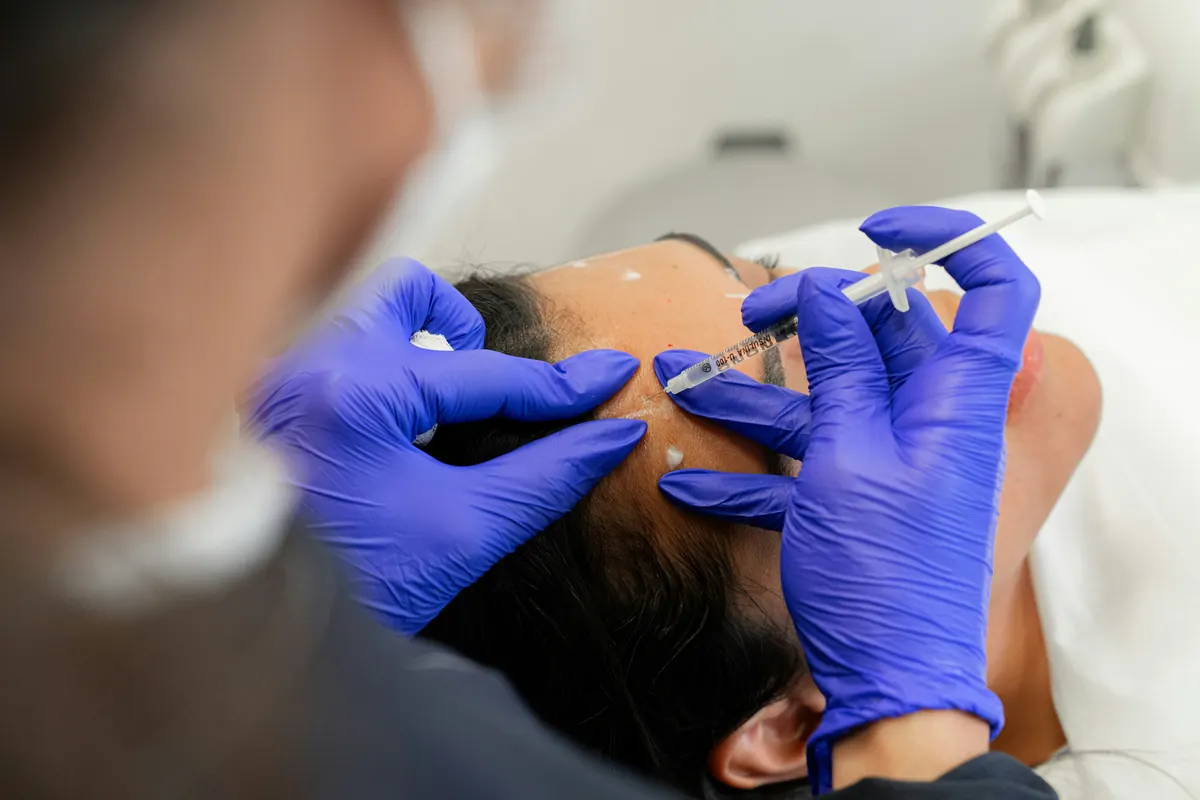
But both labels independently specify a dose for one identical job. Treating the glabellar complex, the corrugators and procerus, in an adult. Dysport says 50 units. Botox Cosmetic says 20. Two manufacturers, two assays, two trial programmes, arriving at those two numbers for the same anatomical task.
That gives you a defensible ratio for that one indication: about 2.5 to 1. It is not a conversion factor. It is two labelled doses for the same treatment, sitting side by side.
Clinical practice commonly uses 2.5 to 1, and sometimes 3 to 1 on larger or stronger muscles. Both are consistent with the labels for the glabella and neither is licensed as a general rule. That is the accurate position, and anyone telling you there is one true conversion number is overstating it in either direction.
4. So what does 100 units of Dysport equal?
People ask this a lot, so here is the arithmetic done properly, with the caveat attached rather than buried.
| Dysport units | At 2.5 to 1 | At 3 to 1 |
|---|---|---|
| 50 (the labelled glabellar dose) | 20 Botox units | About 17 |
| 100 | 40 Botox units | About 33 |
| 150 | 60 Botox units | 50 |
| 300 (a full small vial) | 120 Botox units | 100 |
Use that to sanity-check a quote, not to plan a treatment. The ratio is derived from one indication, your injector is dosing your muscles rather than a table, and the labels do not license the conversion. What it is genuinely good for is spotting a number that makes no sense.
5. The pricing trap, with real published rates
Now the part that costs people money.
Because Dysport takes about two and a half times the units, a clinic can advertise a per-unit rate at roughly a third of its Botox rate and be charging you about the same. It looks like a bargain because the number is smaller, and the number is smaller because the units are smaller.
We found three clinics doing exactly this in one city while researching Houston:
| Clinic | Botox | Dysport | Dysport in Botox terms |
|---|---|---|---|
| BotoxRN, Houston | $12 per unit | $3.50 per unit | About $9 to $10.50 |
| River Oaks MedSpa | A single published range, "$5 to $14.50", covering either drug | Unclear by design | |
| A Houston plastic surgery med spa | $10.50 promotional | $4 promotional | About $10 to $12 |
None of that is dishonest and Dysport is a good product. But $3.50 is not a discount on $12, and a range covering two drugs without saying which sits where is not a price you can compare.
Work it through on the first row. A glabellar treatment is 50 Dysport units at $3.50, so $175. The same treatment in Botox is 20 units at $12, so $240. Dysport is genuinely cheaper there, by about 27%, which is a real saving and nothing like the 70% the per-unit figures imply. Our guide to which Botox deals are real covers the other ways a rate misleads.
6. Dysport units by treatment area
Only the glabella is labelled, at 50 units in five injections of 10. The words forehead, crow, lateral canthal, masseter and lip do not appear in the Dysport prescribing information at all, so every other per-area figure in circulation is Botox convention with the ratio applied to it. Broadly: a forehead runs 30 to 75 Dysport units, crow’s feet 30 to 60 for the pair, a brow lift 10 to 30, a lip flip 10 to 15, and the masseter 100 to 150 for both sides.
Read those as the Botox equivalents and they stop looking alarming: 75 Dysport units for a forehead is roughly 30 in Botox terms. Our full guide to Dysport treatment areas gives every area with its dose, its Botox equivalent and whether it is labelled or derived, along with the ptosis figures from the trials. Our units guide covers Botox dosing per area, and Botox by facial area covers what each area actually achieves.
7. Vial sizes, and why they matter to you
Dysport comes in 300 or 500 unit vials. Botox comes in 50, 100 or 200.
A glabellar treatment is 50 Dysport units, so a single treatment uses a sixth of the smaller vial. That has two consequences worth asking about:
- Vial sharing is normal. One vial covers several patients, which is ordinary practice and not a concern in itself.
- Reconstituted Dysport lasts 24 hours. The label requires refrigeration at 2 to 8 degrees and disposal after 24 hours. So "was this mixed today" is a fair question, and a clinic that treats Dysport patients on set days is doing something sensible rather than inconvenient.
Dilution matters more here than with Botox, because a larger reconstitution volume is part of why Dysport diffuses further. That diffusion is discussed in the timeline guide, along with why it cuts both ways.
8. Switching between the two
People switch, and it is usually uneventful, but two things are worth doing.
Tell the new injector what you had and how much. Not just the brand: the unit count. "I had 20 units of Botox in my frown lines and it lasted ten weeks" is a genuinely useful handover. "I had Botox" is not.
Expect the number on the invoice to change dramatically and the treatment not to. If you move from 20 Botox units to 50 Dysport units, nothing has escalated. If you move from 20 Botox units to 20 Dysport units, you have quietly been underdosed by about 60%, and that is the single most common way a switch disappoints.
Our Dysport against Botox comparison covers the rest of the decision.
9. The four questions that settle any quote
- Which product, by name? Not "tox", not "the injectable".
- How many units of that product? A number, not a package name.
- What is the total in dollars? This is the only figure comparable across brands.
- Is there a minimum spend, and does my treatment reach it?
Ask those four and the per-unit rate stops mattering, which is the point. A rate is a number about the drug. A total is a number about your treatment.
The full Dysport guide is the parent page for this cluster, and the timeline guide covers onset and duration.
What it actually costs. The conversion above is why an identical per-unit price is not an identical bill. How much Dysport costs works it through on real published clinic rates, including the $175 against $650 gap for the same treatment.
Where Xeomin sits. Xeomin doses frown lines at 20 units, the same as Botox, so it avoids this trap entirely. Xeomin against Dysport has the side-by-side.
Frequently asked questions
How many units of Dysport equal Botox?
How much Botox is 100 units of Dysport?
Why does Dysport need more units than Botox?
Is Dysport cheaper than Botox?
How many units of Dysport do I need for my forehead?
Do units of Dysport and Botox cost the same?
What size vials does Dysport come in?
I am switching from Botox to Dysport. What should I expect?
Is there an official Dysport to Botox conversion chart?
Does needing more units mean Dysport is weaker?

Sources
Every figure on this page was read from the documents below rather than from a clinic or a manufacturer's marketing. They open in a new tab so you can check any claim here against its source.
- Dysport prescribing information, FDA via DailyMed
- BOTOX Cosmetic prescribing information, FDA via DailyMed
Know the count before the quote. The unit count is half the bill, and a low per-unit rate recovered by a high unit count is the commonest way a deal is not one. How to tell.
Deciding which area, not how many units? Botox by facial area covers what each zone actually achieves, which four are FDA approved, and the things Botox cannot fix at all.