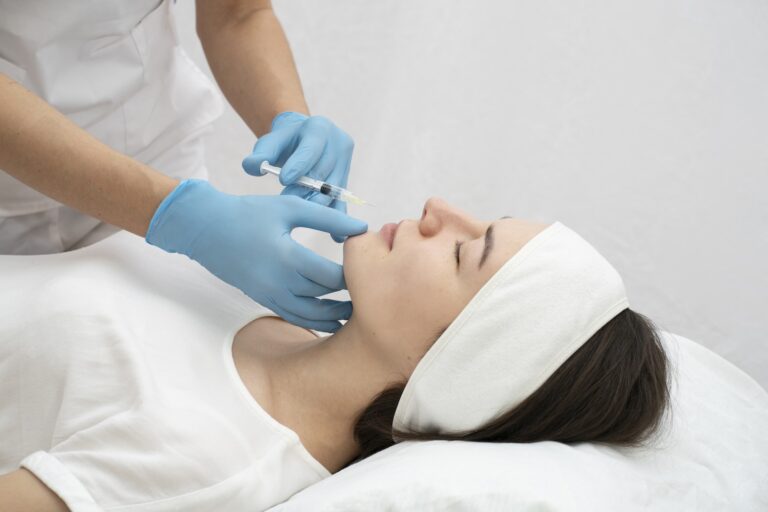
Dysport Before and After, Day by Day
Reviewed for medical accuracy against our Medical Review Board · Last updated 23 August 2026
Part of The Ultimate Dysport Guide
Dysport's own trial data tracks results from day 14 to day 180, and it says three things the photo galleries do not. Results peak at day 14, not day 30. "Up to four months" applies to a minority: by day 120 only 23% were still rated clear or nearly clear. And patients scored their own results 13 to 14 points lower than investigators scored the same faces, which is the measured reason clinic photos look better than your mirror.

We do not publish before and after photographs. We have no clinical photo library, and putting stock images of strangers on a page about results would be dishonest. What we can do is show you the numbers behind what a real result looks like, and explain how to read the photos a clinic shows you.
1. The day-by-day curve, from the trials
This is Table 17 of the Dysport prescribing information, from study GL-1: 105 people treated with 50 units for frown lines, 53 on placebo, followed for 180 days. The figures are the percentage rated none or mild for glabellar line severity at maximum frown.
| Day | Investigator, Dysport | Investigator, placebo | Patient, Dysport | Patient, placebo |
|---|---|---|---|---|
| 14 | 90% | 17% | 77% | 9% |
| 30 | 88% | 4% | 74% | 9% |
| 60 | 64% | 2% | 60% | 6% |
| 90 | 43% | 6% | 36% | 6% |
| 120 | 23% | 4% | 19% | 6% |
| 150 | 9% | 2% | 8% | 4% |
| 180 | 6% | not reported | not reported | not reported |
Almost everything worth knowing about Dysport results is in that table, and it is on page 24 of a document nobody reads.
2. Results peak at day 14
The highest figure in the whole dataset is day 14, at 90% by the investigator's assessment and 77% by the patient's. Day 30 is marginally lower. Everything after that declines.
Two things follow. First, if you are judging your result, day 14 is the right day. Earlier and it has not finished; later and it has started to fade. This is also why a two week review appointment is the industry norm rather than a sales device.
Second, the popular claim that Dysport "works in two to three days" is not in the label at all. The earliest measurement in these trials is day 14, and the label's primary endpoint is day 30. Something is usually happening by day three in practice, and injectors observe it consistently, but it is clinical convention rather than a labelled figure. Our page on how long Dysport lasts goes through the onset question in detail.
3. Why the doctor sees a better result than you do
This is the finding we did not expect, and it is measured rather than theorised.
At every single time point, patients rated their own results lower than the investigators rated the same faces. At day 14 the gap is 13 points, 90% against 77%. At day 30 it is 14 points, 88% against 74%. The gap narrows later as everyone agrees the effect is fading.
Nobody is wrong here. Both groups used the same four-point scale on the same faces, and the label reports both because the primary endpoint required them to agree. It is simply the case that the person who sees your face every day in the mirror is a harder marker than the clinician seeing you every few weeks.
The practical value of that is real. If your injector says your result looks great and you are less sure, you are both probably reporting accurately, and a 13 point systematic gap is the expected outcome rather than a sign of being fobbed off. It is also the honest explanation for why clinic photographs consistently look better than your own reflection: they are graded by the person on the flattering side of that gap, in good lighting, at peak.
4. How often it works at all
The three glabellar trials measured "treatment success" on a deliberately demanding endpoint: a severity of none or mild, and at least a two grade improvement from baseline, and at maximum frown, and agreed by both the investigator and the patient.
| Study | Dysport | Placebo |
|---|---|---|
| GL-1 | 58 of 105 (55%) | 0 of 53 (0%) |
| GL-2 | 37 of 71 (52%) | 0 of 71 (0%) |
| GL-3 | 120 of 200 (60%) | 0 of 100 (0%) |
| All three combined | 215 of 376 (57%) | 0 of 224 (0%) |
So roughly four in ten people did not meet that bar. That is not a failure rate in any ordinary sense: plenty of those people improved, just not by two full grades at maximum frown with both assessors agreeing. Look at the softer measure in the first table and 90% were at none or mild by day 14.
The number is still worth carrying into a consultation, because it is the honest counterweight to a photo wall. Somewhere between a third and a half of people get a result more modest than the pictures you are shown, and the pictures are not fake. They are the top of the distribution.
5. The placebo column, which is the real proof
Look again at the placebo column above: zero out of 224. Across three trials, not a single person given a placebo injection hit the composite endpoint.
That is an unusually clean result for an aesthetics product, and it is the strongest evidence on this page. It rules out the explanations that usually complicate cosmetic trials. It is not people convincing themselves, not the massage of being injected, not regression to the mean. In the softer day 14 measure, 17% of placebo patients were rated none or mild by an investigator, which shows the scale has some give in it. On the strict endpoint, nobody on placebo qualified at all.
Whatever else is uncertain about Dysport, that it works on frown lines is not.
6. What "up to four months" actually means
The label says treatment "reduced the severity of glabellar lines for up to four months," and every clinic repeats it. The day-by-day table shows what it is built on.
Day 120 is four months. At day 120, 23% were still rated none or mild by the investigator and 19% by themselves. So four months is real, and it describes roughly one person in five.
The median tells a different story. By day 90, three months, the investigator figure is 43% and the patient figure 36%, so the typical person has lost half the effect by then. That matches the label's other instruction, which is that Dysport should be given no more often than every three months: the minimum interval and the point at which most people notice it fading are the same date, which is not a coincidence.
Planning on three treatments a year is realistic. Planning on four months of full effect is optimistic for most people. The cost page works the annual arithmetic through.
7. What to expect, week by week
- Days 1 to 3. Small bumps at the injection points settle within an hour. Possible headache, at 9% against 5% on placebo. Nothing has changed yet, and nothing should have. Bruising, if any, is most visible around days 2 to 4.
- Days 3 to 7. Movement starts to feel different before it looks different. Most people notice they cannot frown as hard before they notice the line has softened.
- Days 7 to 14. The result arrives and reaches its peak. Judge it here.
- Day 14. The right day for a review, and the right day for photographs if you are taking your own. Raise asymmetry now: adjustments are easy at this point and awkward later.
- Days 30 to 60. Close to peak, drifting down. Investigator ratings go from 88% to 64% across this window.
- Days 60 to 90. The obvious fade. Around day 90 the typical person is halfway back.
- Days 90 to 120. Most of the effect is gone for most people, and this is when the next treatment is normally due.
If you want to track your own, photograph yourself at maximum frown, in the same light, at day 0 and day 14. Maximum frown matters: that is what the trials measured, and a photograph at rest will show you much less difference because much of what you see at rest is skin rather than muscle.
8. How to read a clinic's before and after photos
Clinic photographs are usually real and still misleading, for reasons that have nothing to do with dishonesty. What to check:
- Is the "after" at maximum frown, like the "before"? The commonest distortion is a hard frown before and a relaxed face after. That comparison is meaningless.
- Same lighting, angle and distance? Overhead light exaggerates lines. Flat frontal light erases them. A change of lighting alone can produce a convincing before and after with no treatment at all.
- How many days after? If it does not say, assume day 14, the peak.
- Makeup in the "after" only? Very common, rarely mentioned.
- Was anything else done? Filler, resurfacing or a peel in the same period changes what you are looking at.
- How many cases are shown? Ten photographs from a clinic that treats a thousand people a year are the top 1%, and given that 57% met the trial endpoint, a gallery where everyone is transformed is not a representative sample.
None of this means do not look at them. It means ask "how many units, which brand, and how many days after" for any photograph you find persuasive. A clinic that can answer instantly is telling you something good about its record-keeping.
9. Other areas, and why there is no data
Every figure on this page is for frown lines, because that is the only cosmetic area Dysport is approved for and the only one with trial data. Searches for Dysport before and after on the forehead, crow's feet, a lip flip or the jaw are asking about off-label uses, where no manufacturer has published an efficacy dataset at all.
What carries across is the shape of the curve: onset over the first week, peak around two weeks, noticeable fade by three months. What does not carry across is the success rate, and two areas are genuinely different. A lip flip fades faster than frown lines, often noticeably by six to eight weeks. Masseter slimming is far slower, because the change comes from a thick muscle reducing in bulk over months rather than a line relaxing, so a two week photograph of a jawline shows almost nothing. Our page on Dysport treatment areas covers each one.
10. When it will not work, and you can predict it
The trials excluded people with "a substantial inability to lessen glabellar lines, even by physically spreading them apart." That exclusion is a free self-test, and it is the most useful sentence in the label for anyone about to spend money.
Put a fingertip either side of the line between your brows and gently pull the skin apart. If the line disappears, it is being held by muscle and a toxin will treat it. If the line is still there with the skin stretched flat, it is etched into the skin itself, and no dose of any botulinum toxin at any price will remove it. That needs resurfacing, filler or time.
The people who post that Dysport did nothing for them are very often people whose lines would have failed that test. It is worth doing before you book rather than after you pay. Our page on frown lines and the glabella covers what each option actually does, and the myths page covers the rest of the expectations that get set wrongly.
Two other predictors from the label. Marked existing ptosis and deep dermal scarring were both exclusion criteria. And the trials enrolled adults aged 19 to 75, but the cosmetic indication is written for adults under 65, so if you are older than that you are outside the approved population for the one cosmetic use it is approved for.
Frequently asked questions
When will I see Dysport results?
When is the best time to take an after photo?
How long do Dysport results last?
Does Dysport actually work?
Why do only about half of people meet the trial success bar?
Why does my result look worse to me than to my injector?
Are clinic before and after photos trustworthy?
Is there before and after data for the forehead or crow's feet?
How can I tell in advance whether Dysport will work on my lines?
Will my second treatment work better than my first?
Do results look better at day 30 than day 14?
Why do you not show before and after photos?

Sources
Every figure on this page was read from the documents below rather than from a clinic or a manufacturer's marketing. They open in a new tab so you can check any claim here against its source.
- Dysport prescribing information, FDA via DailyMed
- Botulinum toxin, American Society of Plastic Surgeons
Know the count before the quote. The unit count is half the bill, and a low per-unit rate recovered by a high unit count is the commonest way a deal is not one. How to tell.
Deciding which area, not how many units? Botox by facial area covers what each zone actually achieves, which four are FDA approved, and the things Botox cannot fix at all.